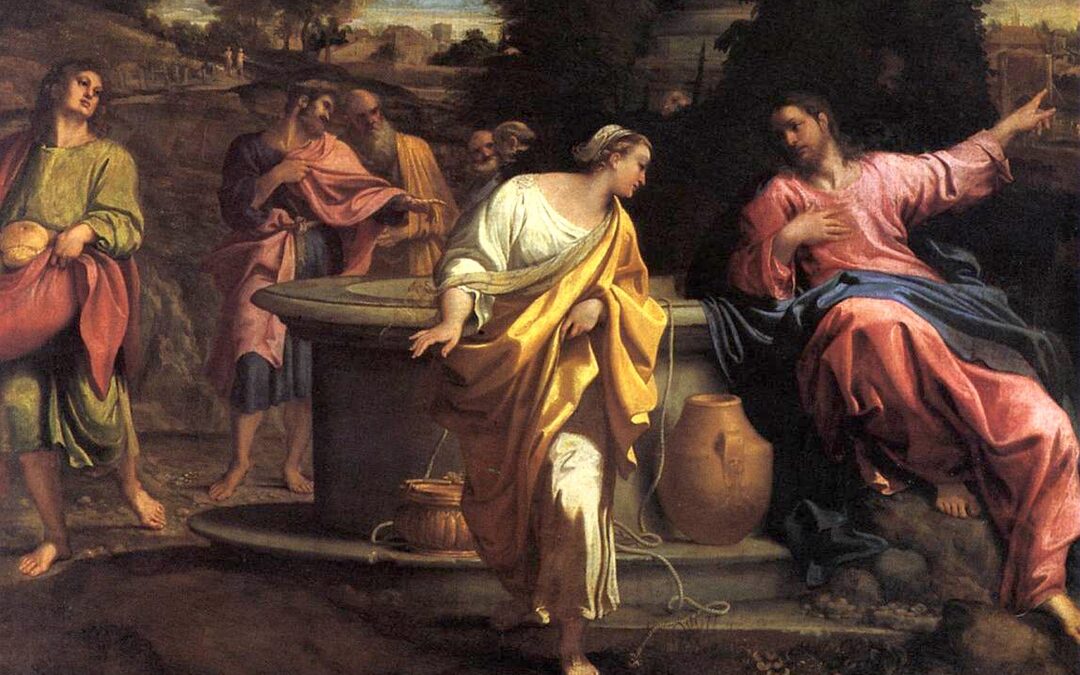
(Annibale Carracci, Christ and the Samaritan Woman at the Well, Pinacoteca di Brera, Milan, 1594)
Sunday, 8 March 2026
THIRD SUNDAY OF LENT – YEAR A
Commentary on the Sunday Gospel
Jn 4:5-42
Our Lenten journey today has a special stop, Jacob’s well between Judea and Samaria. The scene of a courtship rich in messages and meanings for our lives, set against the backdrop of sister water. After all, that Samaritan woman, who appears to be a cheerful woman who has had five husbands and is not happy with her sixth, actually represents our thirst, the desire for fulfilment that is present in the heart of each one of us.
The expression ‘At that time, Jesus came to a town in Samaria’ omits the premise found in John’s Gospel, which says, ‘He had to go through Samaria‘. This need is not due to geographical reasons or the shortest route, but is understood in the sense of salvation. In this place “there was Jacob’s well”, an element that represents, in the paths that cross the desert, a centre of life: around the well, cities developed, daily life, encounters, quarrels; around the well, loves and families were born. This also happened with the patriarchs, in this place, Shechem with the oak of Mamre, linked to the story of Abraham. Around a well, Jacob courted Rachel, as did Moses. Today, it is Jesus who courts a woman.
This passage is rich in allusions and misunderstandings, typical of love scenes. Jesus presents himself in his humanity, ‘weary from his journey‘ and alone. To court the woman, rather than doing as we do, flaunting our power and brilliance, Christ shows himself to be needy, sharing his desire: ‘Give me a drink‘.
‘Why you?’ indicates the woman’s amazement, her cultural distance, but also her desire to be courted. And in fact, Jesus makes a qualitative leap in the dialogue, responding, ‘If you knew the gift of God…’, an expression that, if each of us heard it with our own ears, would pierce our hearts! We are content with small desires, with substitutes, but if only we knew this immense gift that quenches all our desires, how beautiful our lives would be. And the dialogue between the two rises to a higher level, until Jesus calls her husband into question.
“Go, call your husband and come back here” expresses the highest level of desire, the fullness of joy. Jesus does not denounce the woman, he does not condemn her, but waits for her to respond to the invitation. And she reveals herself for what she is, a sincere woman. The expression ‘I have no husband’, in its conciseness and immediacy, expresses the dissatisfaction of an entire life. How often do we ‘have no husband’, but out of pride we do not even admit it! Perhaps this alludes to the six idols of Samaria, the term ‘ba‛al’ itself, which indicates the idol, also indicates the husband.
All of us, deep down, live in search of these idols, these six husbands. The first two, which serve to satisfy the most basic needs, are food and sex. Eating and reproducing are the only reasons for living for animals. Almost all the advertising marketing that surrounds us is based on these two needs. In some cases, when we are fortunate enough to realise that these two desires are not being satisfied, we move on to two other husbands: knowledge and art. Two seemingly noble and wonderful husbands, with the risk that the desire for possession can destroy relationships and lead us to a level of pride and isolation. If knowledge and beauty fail to quench our desire for fulfilment, we risk encountering the fifth husband, anguish. The abyss that arises from the search for the highest peaks, which can only be replaced by the last husband, despair.
It is precisely despair that leads the woman, at noon, to seek water again at the well. She is not, therefore, an unfaithful woman, because after her first husband she would have been stoned. If anything, she has been abandoned by these husbands, by these idols, by these ba‛als that delude our lives every day. And the woman realises that Jesus is on another level and has grasped the heart of her problem, and she says, ‘Sir, I see that you are a prophet!’. Everyone knew that she had had six husbands, but only Jesus saw in this a beautiful desire for fulfilment.
“Believe me, woman,” Jesus replies, using this expression which in John is reserved only for his mother at the wedding at Cana and beneath the cross, for the forgiven adulteress and for Mary Magdalene on Easter morning. So this Samaritan woman must be important in Christ’s life! The encounter with God does not take place in a specific place, in a temple or in a holy city, but in dialogue. Spirit and truth represent the search in brothers, sisters, in all creation, which is the word of God. And what does the woman do? She leaves her empty jar and runs joyfully to announce the news to the city. Worship, after all, refers to ‘putting in the mouth’, to a sense of hunger or thirst that opened the dialogue between the two. And the woman’s announcement leads an entire city to encounter God in the most beautiful way.
One last note on the woman’s humility: after the announcement, the people believe because they encounter God, not because the woman continues to talk about God, ‘it is no longer because of your words that we believe‘. How effective would our evangelisation be if, in the end, it were not our reflection that was praised! This humility expresses the style of the Canticle of St Francis, which concludes with the beautiful expression: ‘Cum grande humilitate’ (FF 263).
We sincerely wish you a happy Sunday.
Laudato si’!
A courtship rich in messages and meanings for our lives. I really like this strange definition of this gospel, and it is basically what God does every day with each of us. He courts us…
Grazie Catherine, after all, it’s nice to be courted by God… Have a good Sunday.
Thank you for this commentary on the Gospel, which is always very inspiring.
Grazie Joseph, I wish you a pleasant Sunday
Bon dimanche à tous !
Grazie Elise, bon dimanche à toi aussi.
Magnifique texte, magnifique peinture. Tu as rendu la rencontre entre le Christ et la Samaritaine très proche et humaine.
Le désert, et en particulier le puits, est aussi un lieu de rencontre très précieux. Je le sais pour l’avoir vécu… Cette rencontre est très vraisemblable. Merci
Thank you for sharing…I love the phrase .”if you knew the gift of God”… it goes straight to my heart and shakes me up.