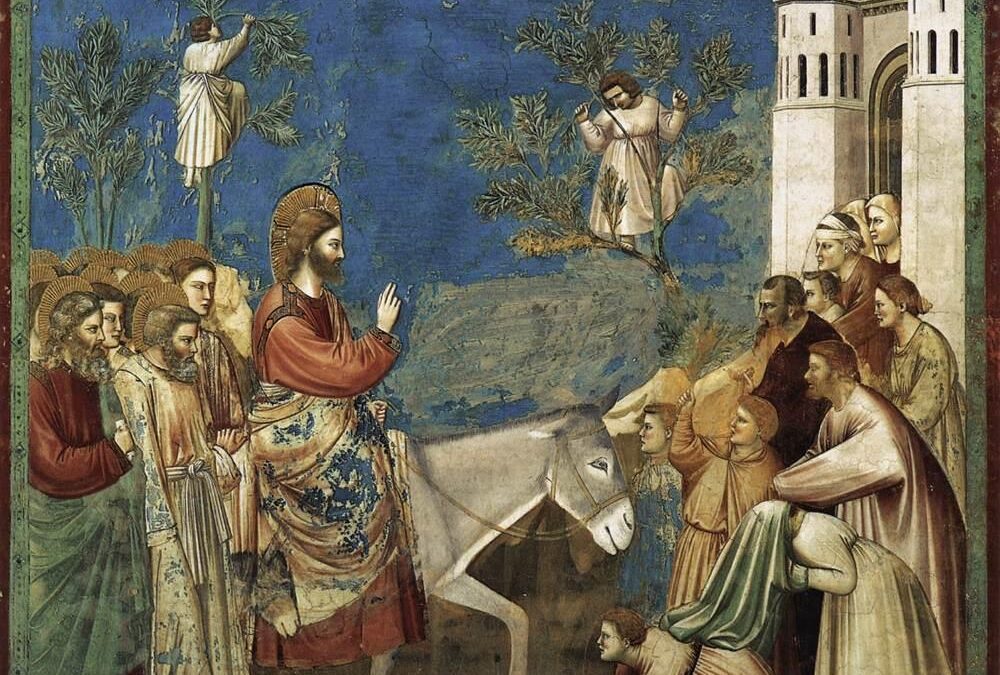
(Entry into Jerusalem, Giotto di Bondone, Scrovegni Chapel, Padua, 1303-1305)
Sunday, 29 March 2026
PALM SUNDAY – YEAR A
Commentary on the Sunday Gospel
Mt 21:1-11
Today, as we approach the end of Lent, which will conclude on Thursday with the Easter Triduum, we arrive at the gates of Jerusalem. Jesus does not tell us today when the kingdom of God will come, but he reveals how it will come: the King will arrive on a donkey. How beautiful it is to see that God chooses his simplest creatures to communicate his message to us. He asks each of us to do nothing more than untie a donkey; that is all he needs! What does this donkey represent?
Here a prophecy is fulfilled, the first day of the six days that Jesus will live in Jerusalem begins, the time of a new creation. The prophecy is fulfilled through the figure of the donkey. It is the only time in the whole Gospel of Matthew that it says, ‘Go… and you will find’, and a few words later we read, ‘the messengers went and found‘. Ultimately, it is a prophecy of what always happens. Our problem is that we almost always want the king to arrive on horseback and in chariots, with special effects or tanks, and we feel almost disappointed to see him arrive on a simple donkey.
We find ourselves “at Bethphage, near the Mount of Olives,” at the gates of Jerusalem, two places that have a specific meaning that connects us to the cry of the earth and the poor, places of purification before entering the city. Bethphage, in Aramaic בית פגי, literally “house of barren figs”, refers to the people of God who do not bear fruit, and before the fig tree during this Lent we have experienced God’s mercy. The Mount of Olives, to the east, towards the Beautiful Gate, through which the Messiah was to pass in triumph as he entered Jerusalem, passing through our limitations.
In the mission, Jesus “sent two disciples”; we do not know which ones, we only know that the sending is always plural. There is consistency in sending his disciples two by two “to the village opposite”. Just as we do not know the disciples, we do not know the village. It seems strange, because the scene is clearly set in the village of Bethphage and on the Mount of Olives, but perhaps the village opposite tells us that we are always in a land of mission, a place where God sends us. And here is the prophecy: ‘you will find a donkey tied up, and with it a colt’, a donkey that lives the vocation of humble service, a sign of meekness since the prophecy of Zechariah. It seems almost offensive to find an image of God in a donkey; it could seem almost blasphemous, just as disappointing as the image of the hen evoked in the lament over Jerusalem. Not a noble eagle soaring in the sky, but a hen, when he said: “How often I wanted to gather your children together as a hen gathers her brood under her wings, and you were unwilling!” Not a wild horse pulling war chariots, but a humble donkey taking on all the sins of the world.
This donkey and this colt, which we can find every day in the village in front of us, protagonists of the story, have two characteristics. First of all, they are tied up. They are not free. We must cross a boundary. This boundary is the tie that frightens us. Here is the command: untie this donkey and this colt. Free within us this image of God who comes to serve, an image that we find in our daily lives, in our village in front of us.
“And if anyone says anything to you, reply, ‘The Lord needs them, but he will send them back immediately.'” The only time Jesus calls himself “Lord” in the entire Gospel is in this scene. And he tells us that he is Lord because he needs to be. He needs to untie love, service. To untie humility, smallness. The great dignity of obedience. While there is ‘the Lord’ who needs it, there are ‘the lords’ who possess it. Who knows what exchange of glances there was between the colt and Jesus? We all have in mind the sweet gaze of a donkey, obedient and so useful. I like to imagine the sweetness of this exchange of glances!
They throw cloaks on this foal and on the donkey, a sign in the Torah of essentiality, even of life or death. Everyone had to have a cloak for the night, even if borrowed, because it had to be returned, otherwise one risked dying of cold in one’s sleep. And Jesus sits on these cloaks. The donkey is the king’s throne, through which he enters Jerusalem. Descending from the Mount of Olives, creation, as always with its ups and downs, marks our daily lives and the places of our prayer and dialogue with God, and here ‘the crowd, very large’, praised him. It is almost as if we can hear this original ‘Laudato si’ sung by a crowd. ‘Hosanna to the Son of David! Blessed is he who comes in the name of the Lord! Hosanna in the highest!” is the song of praise of the promised land, the final song of the exodus. Here is the peace of heaven, the peace of all creation, when, by unleashing God’s humble love, we can quench the thirst of the earth that needs him!
Jesus faces a world that struggles to welcome him, after two thousand years in which people still ask themselves as he passes by: ‘Who is this man?’. Deep down, we all still ask ourselves this question. In many passages of Franciscan sources there are references to humility, perhaps the most beloved spouse of St Francis, who reminds us that: “Blessed is the servant who does not consider himself better when he is praised and exalted by men than when he is considered vile, simple and despicable, for what a man is worth before God is what he is worth and no more. Woe to that religious who, placed high by others, does not want to come down of his own accord. And blessed is that servant who is not placed high of his own accord and always desires to place himself under the feet of others” (FF 169).
We sincerely wish you a happy Palm Sunday,
and a fruitful Holy Week leading up to the Lord’s Easter.
Laudato si’!
Dimanche des rameaux ou le dimanche de toutes notre consecration au Seigneur. Nous l’attendons chaque année avec impatience pour entrer dans la gloire avec le Seigneur et célébré son rayonnement tacheté d’humilité. Le Seigneur sur le dos de l’âne en ce dimanche nous enseigne que la gloire ne doit pas etre ostentatoire, mais doit se manifester au travers de menus symbole.
Hosanna au plus haut des cieux ! ..
As per the homily yesterday, unlike the world today Jesus choses a donkey other than a horse as was the case at the time. We pray that we remain humble and in the same manner respond to the cry of the Earth in simple and humble ways…
Dear Antonio may this Holy Week strengthen our commitment to being with the olivo, instruments of peace and voices for those suffering under the weight of greed and conflict. Let us transform our sorrow into solidarity, remembering that our faith calls us to stand firmly with the vulnerable and to work tirelessly for a world where dignity and justice prevail for all.
Wishing you a Week of deep reflection and spiritual strength.
Seamos artesanos de la Paz!!!
Ouvrons nos cœurs et marchons fidèlement avec Jésus en chantant Hosana au plus haut des cieux, mais aussi en vivant sa passion avec lui!
I just discovered that it was in this scene that Jesus called himself “Lord” Matthew 21:11-11. “If anyone says anything to you, say” the Lord has need of them ” Jesus knew questions would be asked and he gave the disciples the reply to give when the need arises. His name opens doors and brings to accomplishment all that we ever desired.
In mounting the donkey, no resistance from the donkey. It implies that Jesus communicates also with animals not only human.
Today reveals the Lordship of jesus. When the question arose from the crowd”who is this? they asked. The crowds responded ” this is the prophet Jesus from Nazareth of Galilee”
It’s imperative that we place ourselves in the crowd and respond to questions when they arises. Jesus is Lord.
Happy palm Sunday.