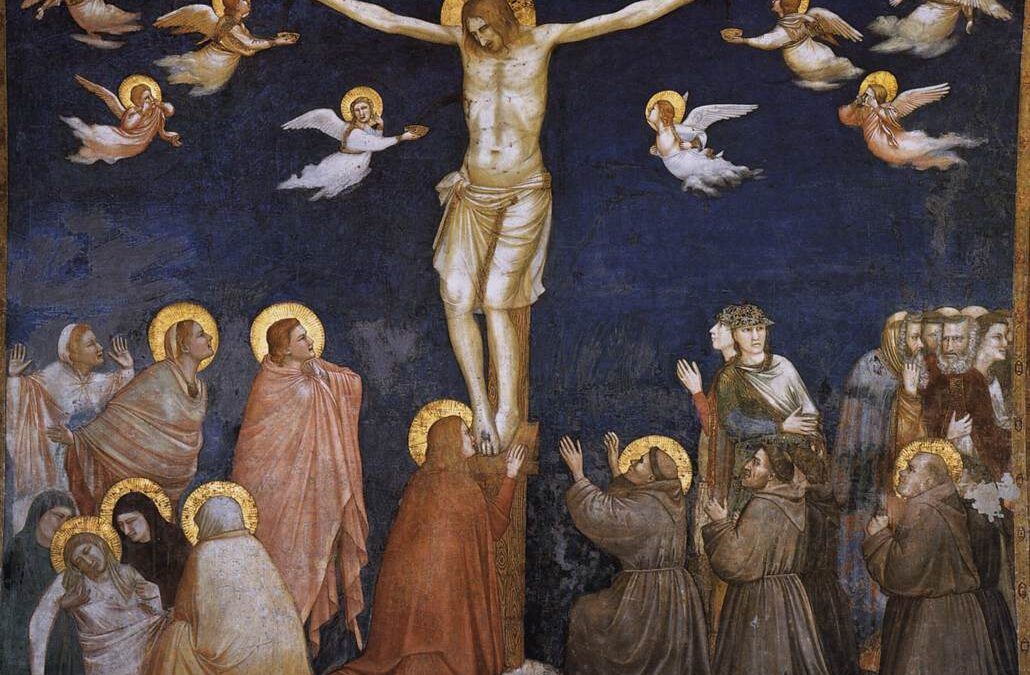
(Giotto and collaborators, Crucifixion, Lower Basilica of St. Francis, Assisi, 1308-1310)
Friday, 3 April 2026
GOOD FRIDAY – YEAR C
Commentary on the Gospel
Mt 27:32-56
We are at the climax of the history of salvation, with the liturgy of the Easter Triduum. We invite you to slow down, to take the time to reflect deeply and pray on these verses of the Word. The reading of Matthew’s passages during these solemn days focuses on the setting of the events, immersed in creation. A garden, a mountain and a garden. Today we find ourselves on Mount Golgotha, a place of torture and death. We find ourselves before the most important story in the entire Gospel. Here, today, on this mountain outside Jerusalem, we have the opportunity to encounter the face of God. Yesterday, in the garden, Jesus taught us how to pray. Today he teaches us how to live.
For this reason, ‘telling’ today is an impossible task. We will only suggest a few ideas, inviting you all to slow down, almost to stop today and linger over each individual verse. Each passage deserves a day, a week of silent meditation. In each verse here, we find an explanation of the whole of Scripture, of the prophets, of the law, of Paul’s letters, of the Apocalypse, of patristic theology, of medieval theology, of the magisterium of the Church, of Laudato Si’. Here we encounter creation speaking to us of this death, the sky darkening, the veil of the temple – made by human hands – being torn. It is up to us to choose to fix our gaze on the glory of God, which is manifested today in this torn body hanging from the cross, as the criminal and the centurion do, and be saved; or to do as the high priests, the Pharisees and the crowd do, who mock him, but who are nevertheless saved by God’s mercy.
‘As they were going out, they met a man from Cyrene, named Simon’, the scene opens with an immigrant, a ‘poor wretch’ returning from the fields, coming from Libya, from Africa. Those who carry the crosses, or help to carry them, are never rich or powerful, but always those who are looked down upon. And this man, despite himself, becomes one of the protagonists of the scene. He is not Simon, the disciple on whom the Church will be founded, but another Simon. An unwitting disciple, but one who will follow the Christians, mentioned in the Letter to the Romans with his children and wife Evodia, and mentioned in the Gospel of Mark as the father of Alexander and Rufus.
Almost always, in suffering, we seek anaesthetics, ‘they gave him wine mixed with gall to drink’, but he does not want it. The scene of stripping, always heartbreaking and humiliating, when ‘they divided his garments, casting lots‘. The majesty of God in possessing nothing of his own. ‘Two thieves were crucified with him, one on his right and one on his left’. The cross is the tree that stands out on this mountain, reminding us of the tree of life rejected by Adam, whose skull is often depicted at the foot of the cross. Jesus climbs this tree of death to water this skull with his blood, which is ultimately the death of each one of us, in order to give life. His blood waters the soil like the blood of so many eco-martyrs who have fought for social and environmental justice. The blood of martyrs is the seed of Christians, as Tertullian says. And in that moment of Christ’s glory, two criminals are present in the places eagerly desired by James and John, who wanted to be “one on the right and the other on the left”. How much we have to learn to pray! Jesus in the middle, among our miseries, in solidarity with all humanity represented on the right and on the left: those who are evildoers and those who are convinced they are not.
How much we Christians and citizens of the world have to learn from this prophetic image! When we understand that true politics is not about occupying positions of power to be defended with crusades and parties, but about putting the least of the least first, truly listening to the cry of the poor and of the earth, then we can truly hope for a better world. How important it is for Christians to commit themselves to prophetic politics! If our king is Jesus crucified, then there is truly hope. It is a certain hope, because alongside a world made up of a minority of kings who fuel wars, abuse and corruption, throughout history humanity has known human rights, solidarity and integral ecology, built by countless kings who choose, silently and every day, to put themselves at the service of others.
“Those who passed by” together with “the chief priests, with the scribes and the elders” and, moreover, “even the thieves crucified with him insulted him in the same way”. A unanimous chorus of criticism and insults against this God who shows his majesty from the wood of the cross. And how relevant this word is today, how much criticism is levelled at this God who accepts suffering, who takes on our crosses?
“At noon, darkness came over the whole land until three in the afternoon.” Creation speaks to us. Every day. But today everything takes on a special meaning. We find ourselves in a night that begins in the garden of the Jerusalem oil mill, marked by trials and insults, by the confusion of the street, by the Mount of Skulls. Apparently we are in the sixth hour, the hour when the sun is at its highest point, the hour of greatest light, but also the hour of Adam and Eve’s disobedience. Sin is the moment when creation separates itself from the Creator, and in fact Adam and Eve hide themselves. Darkness hides from the strongest light. On Golgotha, the end of the world takes place. The world of sin ends. We do not have to wait for another end of the world; it is already described here in the Gospels, with this eclipse.
‘My God, my God, why have you forsaken me? Jesus cried out again in a loud voice and gave up his spirit‘. Let us not observe a minute’s silence, but rather, as you read this reflection today, we invite you to observe ten minutes of silence. An hour of silence, contemplating this theoria, this ‘spectacle’, with the time it deserves.
Let us dedicate silence before this image.
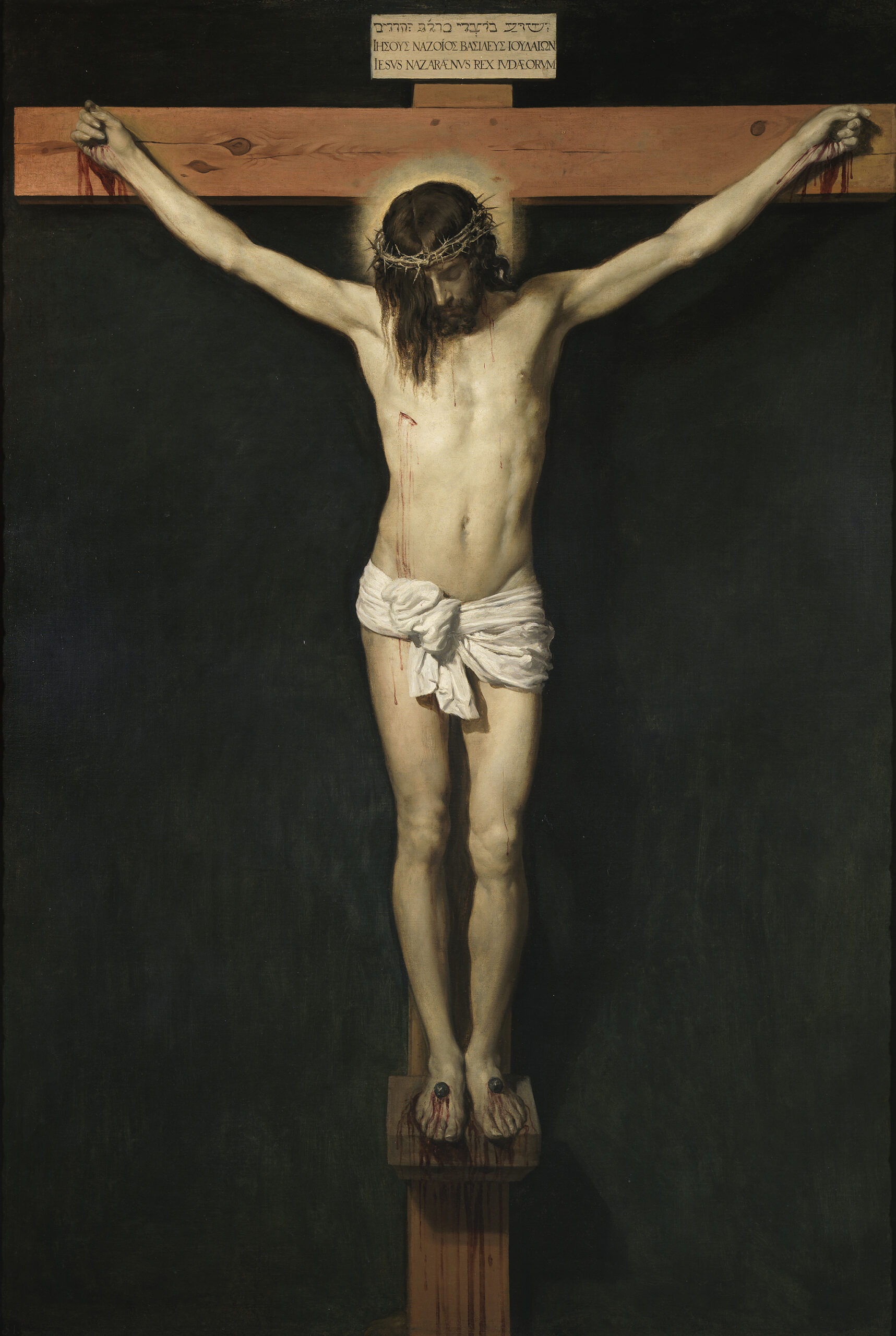
(Diego Velázquez, Christ on the Cross, Prado Museum, Madrid, 1631)
He gave up his spirit. God also breathed his last. Life is inhaling and exhaling. To be terrified of death is to be insatiable; often we only want to inhale, even to the point of bursting. We keep the planet’s resources, relationships, well-being, and our very lives to ourselves, terrified of losing them. God, who created everything through an act of kenosis, stripping himself of his infinity to make room for finite things, now gives us a new creation in the stripping of the cross. A new birth. Without veils, God reveals himself to us. By breathing his last.
The passage closes, mirroring how it opened, with the categories that witnessed this spectacle: power, symbolised by the centurion, and the crowds, that is, the people. The religious figures of the time disappear from the story, their presence lost in the events of this new creation. A new world begins, a new creation, ‘the veil of the temple was torn in two‘. The veil that hid the Holy of Holies is torn, God ‘reveals himself’, shows his face. The waters break, it is a painful birth, Mother Earth is torn apart by earthquakes, the Son is born, who ‘cried out in a loud voice, saying, “Father”. A birth in the pain and sin of the world. We are convinced, with our mental categories, that we are witnessing a scene of death, but it is actually a birth.
‘The centurion and those with him who were guarding Jesus, when they saw the earthquake and what was happening, were seized with great fear and said, “Truly this was the Son of God!”‘. A phrase that arises from the observation and contemplation of this cross. He says this, he who exercised power and death as his profession. We are God’s tormentors, and yet we are the ones who can recognise him in the face of those who suffer.
St Francis, in his beautiful paraphrase of the Our Father, reminds us that: “And lead us not into temptation: hidden or manifest, sudden or insistent. But deliver us from evil: past, present and future” (FF 274). Let us thank the Lord for the immense gift of his life for us, and for teaching us that there is an alternative path to evil. Let us pray on this day of silence that this new creation may be a seed of conversion for us.
Praise be to you, my crucified Lord!
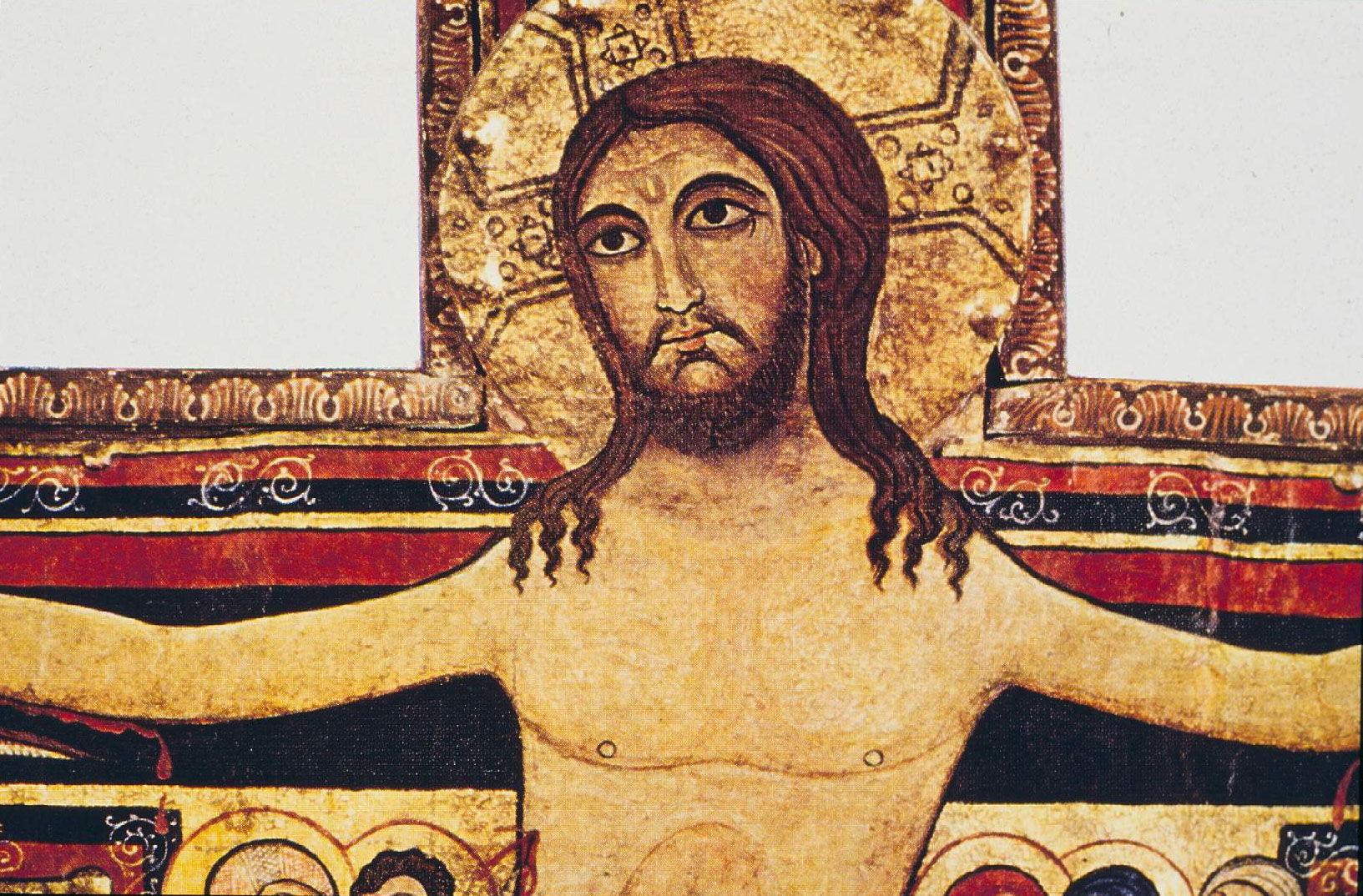
Vendredi Saint ! Aujourd’hui nous commencons la marche de trois au côté de notre Christ. Une marche qui suscitent des emotions multiformes : la douleur, la honte, le regret, …finalement au bout de tous ces tourments la Gloire. Le Dimanche Saint ! Oui, le Seigneur après notre trahison accepte de revenir pour nous dans la gloire.
Avant de vivre cette gloire, je me tourne vers notre Jesus perché sur la croix…et je regarde une seule chose : la couronne d’épines sur sa tête ! oui, après toute la maltraitance, il l’ont dépouillé de tous ses vêtements. C’était sans doute pour l’humilier encore. Mais cette attention a sans doute apporter un soulagement sur ses supplices corporelles. Mais la couronne d’épines, il ne l’a lui ont point ôtée ! Ces épines synonymes de toutes les meurtrissures que nous lui avons infligées. A jamais, je me prosterne devant notre Jesus couronné d’épines, et je lui dis : pardon Seigneur, je reconnais que nous avons été si violent ! Nous n’avons laissé aucun répit à aucune partie de ton corps. Les douleurs de nos péchés, ces épines te les ont fait ressentir…malgre cela, tu nous as gardé une place au paradis : “Aujourd’hui même, tu seras avec moi au paradis”. Et tu nous a confié à ta Valeureuse Maman : ” Femme, voici ton fils”. Merci Seigneur, pour ta confiance et ton amour indéfectible !
Buon Venerdì Santo: che l’amore e il sacrificio portino pace al tuo cuore.
Blessed Good Friday: may love and sacrifice bring peace to your heart.
Selamat Jumat Agung: semoga kasih dan pengorbanan membawa damai di hatimu.
Jesus had to endure all this for our Salvation. When we sin and fail to respond to the cry of the poor and the Earth, in a way we take Christ back to the cross. Simon of Cyrene and Joseph of Arimathea both from different positions in society are outstanding in Christs passion. Lets pray that God gives us the grace that in all walks of life we may respond faithfully to the cry of the poor and the Earth.
Thank you very much for your reflection, I find it very inspiring 😊 I wish you blessed Easter Triduum
Jesus had to endure all this for our Salvation. When we sin and fail to respond to the cry of the poor and the Earth, in a way we take Christ back to the cross. Simon of Cyrene and Joseph of Arimathea both from different positions in society are outstanding in Christs passion. Lets pray that God gives us the grace that in all walks of life we may respond faithfully to the cry of the poor and the Earth.
Love and silence alone are enough before the mystery of God
Many thanks Antonio. I reflect and will come back to you. Many thanks again Antoniom
Belle célébration du mémorial de la mort de notre Seigneur Jésus Christ selon la coutume du peuple Bassa au Cameroun, folklorique certes, mais très profond de sens sur les raisons de la mort du Christ, le témoignage de l’Amour infini de Dieu envers nous les Hommes.
Merci Seigneur pour La croix aussi triste et douloureuse était-elle, c’était pour le salut du monde.
Sous la laideur de la croix, se cache la beauté de l’amour infini de Dieu