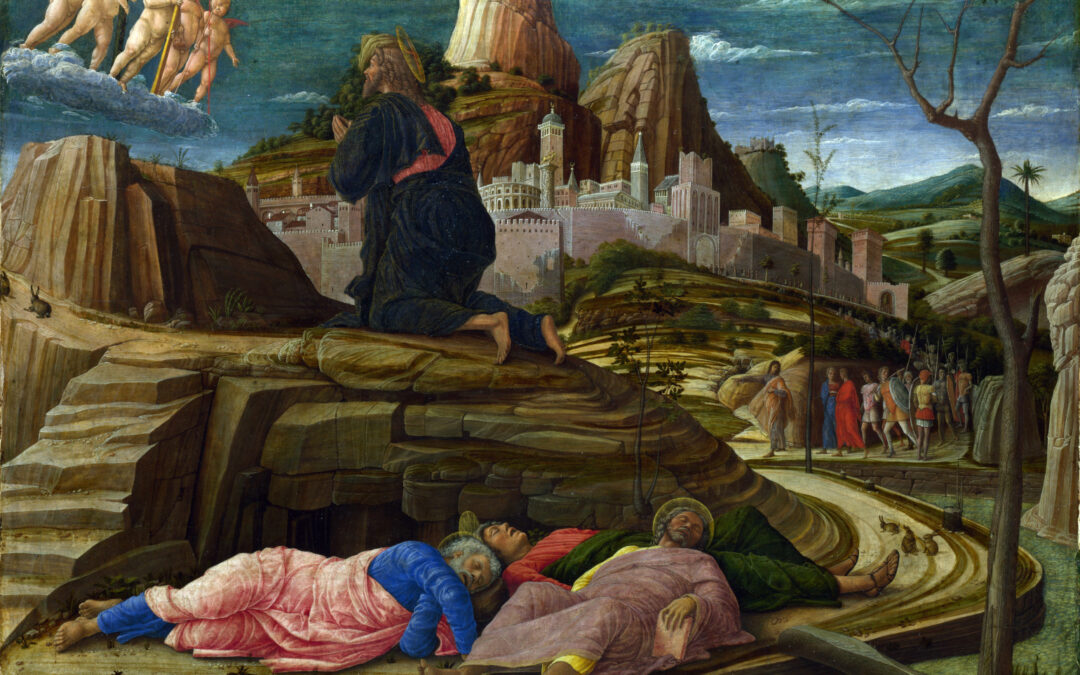
(Andrea Mantegna, The Agony in the Garden, National Gallery, London, 1455)
Thursday, 2 April 2026
HOLY THURSDAY – YEAR A
Commentary on the Gospel
Mt 26:36-46
Today we enter the climax of the history of salvation with the liturgy of the Easter Triduum. With the Easter Triduum, we will also conclude this journey of deepening our understanding of the Gospel, read with the perspective suggested by St Francis’ Laudato Si’ and Pope Francis’ Laudato Si’, in connection with creation. We invite you to slow down, to take the time to reflect and pray on these verses of the Word. For this reason, the reading of Matthew’s passages during these solemn days will focus on the setting of the events, immersed in creation. A vegetable garden, a mountain and a garden. Tonight we find ourselves in the Garden of Gethsemane, in the company of olive trees at the hour of prayer, abandonment and agony of Jesus.
Gethsemane, in Hebrew ‘gat šemanîm’, means ‘oil press’, or perhaps better ‘wine press’, a place where olives are pressed. In Jewish tradition, the press evokes God’s vengeance, for example when the prophet Isaiah says: ‘I have trodden the winepress alone, and none of my people were with me. I have trodden them in my anger and trampled them in my wrath’ (Is 63:3). Today, in this winepress, we know better what God’s vengeance is through the experience of Jesus. Matthew’s narrative describes a man deeply detached from others, who suffers, prays, feels sadness and anguish, a Christ patiens who, thanks to Franciscan culture, has helped us, centuries later, to move away from the ‘glorious’ image of the cross, almost as if God had not even suffered the Passion, knowing that he would rise again. Instead, Matthew, and then the art and culture that developed from the 13th century onwards, are keen to tell us about the agony, the suffering, the weeping of God in the face of trial.
Here we see the return of many themes that we already saw a few weeks ago during Lent, in the scene of the Transfiguration: the dialogue between Father and Son, the search for the face, the company of the three apostles, who do not understand what is before them. Here, almost in contrast to the light of Tabor, darkness descends on this mountain, it is night, and Luke’s narrative recounts all the hours of the night, of the capture, of the trial, of Calvary, of solitude, of the eclipse in which at noon darkness falls over the whole earth. A night that lasts all day, with disappointment and silence. It is the night of the old creation, which precedes the dawn of a new day. It will happen as in the first creation, when there was darkness, and with a word he created light. But today, after the feast of the Last Supper, we enter, a little drunk and a little upset, at the beginning of this very long night, into the enclosure of the oil press.
‘Then Jesus went with them to a place called Gethsemane’. Jesus leaves the Upper Room, leaves a house made of walls, and from this moment on he will pass through palaces and places of torture, in open courtyards, along the streets, to a mountain. From that moment on, he will live entirely outside, immersed in creation and in the cry generated by human justice. A place of habit, every evening this week Jesus retired to pray in “this place”, in this temple. And in fact, Jesus asks his friends: “Watch with me”, he asks almost as a plea. He asks us this on this night, amid the cry we experience every day. We must learn to pray, to ask God not for what we want, but for what is good. Pray for what?
“Pray that you may not fall into temptation.” The temptations are those we saw at the beginning of Lent, in the desert, all temptations: bread, power, God with a magic wand, in a nutshell, the temptation to be “me at the centre”, to possess all things, relationships with others, the planet. And they are also the temptations we have seen in living this Laudato Si’ Lent: individualism, comfort, consumerism and so many other ways in which we have disconnected ourselves from creation and from our brothers and sisters. Prayer is fundamental in our process of ecological conversion. It is not just a nice habit or something we do because the parish or diocese tells us to, but it is the basis for not falling into temptation. Jesus enters the garden, but asks not to be tempted.
“He went a little further, fell face down on the ground,” referring to the terror and anguish that led him to pray in total contact with the earth. A cosmic prayer, in contact with Mother Earth, in which Jesus calls God “Abba,” that is, “Father,” a word that reminds us of the creative word, a new creation, starting from the darkness and evil of the world. First of all, Jesus distances himself from evil and asks the Father: “My Father, if it is possible, let this cup pass from me!”, that is, the cup of suffering that is desired by humanity. God does not want evil; it is human beings who build crosses, inflict suffering on their brothers and sisters, and on all creation. God suffers this evil, and if he could choose, he would prefer this cup to be far from him. But he also flees the temptation of a God with a magic wand, the temptation of power and immunity, praying: ‘But not as I will, but as you will!‘. The root of all evil in the world lies in the exclusion of God, when we put our ego at the centre. ‘My’ will excludes God’s will, the will of good. Jesus has a focused gaze, as Francis will understand with his vow of ‘nothing of his own’. It is not enough to be poor, but in life we must aspire to consider nothing as our own possession, because possession is the opposite of love. In Gethsemane, this becomes incredibly clear.
This is a great teaching of Jesus, precisely in the highest demonstration of his humanity: it was not only God who knew he would rise again, but here was a man who felt torn in his relationship with his father, in the midst of immense injustice. In our injustices, in our prayers, we know that Jesus is at our side, but here he was terribly alone.
“Then he came and found them asleep again, for their eyes were heavy.” Sadness and agony prevent us from seeing grace, from keeping our eyes open. How many heavy eyes there are in our humanity! “Get up, let us go! Behold, the one who betrays me is near.” Get up and pray. Get up and go. This is what to do in the face of evil, even the most unjustifiable. This is the greatest lesson we receive on this night, among the olive trees of the Jerusalem oil mill.
St Francis, in his beautiful paraphrase of the Our Father, reminds us that: “Thy will be done, on earth as it is in heaven: that we may love thee with all our heart, always thinking of thee; with all our soul, always desiring thee; with all our mind, directing all our intentions towards thee and seeking thy honour in everything; and with all our strength, spending all our energy and sensitivity of soul and body in the service of thy love and nothing else; and so that we may love our neighbours as ourselves, drawing everyone with all our power to your love, enjoying the goods of others as our own and suffering their evils with them, and causing no offence to anyone” (FF 270).
Happy Easter Triduum
Laudato si’!
Hey Antonio !!!
Thank you for your kind words and support in prayers
Have a blessed triduum Pascal
Bonjour et merci bcp monsieur Antonio
Thank you very much, God bless you in this Holy Easter Triduum
Ce Triduum Pascal est un moment intense pour communier avec Dieu, un moment profond de méditation et de reconnaissance à Dieu notre père pour la réconciliation par la croix.
Bonne célébration du Triduum Pascal à tous
“La Vida ha destruido la muerte y el Amor ha lavado el pecado”
Reciba un fraterno saludo de Pascua.
Atentamente
Thanks for this reflection… I keep this part specially in my heart: Sadness and agony prevent us from seeing grace, from keeping our eyes open. How many heavy eyes there are in our humanity! “Get up, let us go! Behold, the one who betrays me is near.” Get up and pray. Get up and go.
Have a blessed easter triduum
Thanks for this reflection… I keep this part specially in my heart: Sadness and agony prevent us from seeing grace, from keeping our eyes open. How many heavy eyes there are in our humanity! “Get up, let us go! Behold, the one who betrays me is near.” Get up and pray. Get up and go.
Have a blessed easter triduum