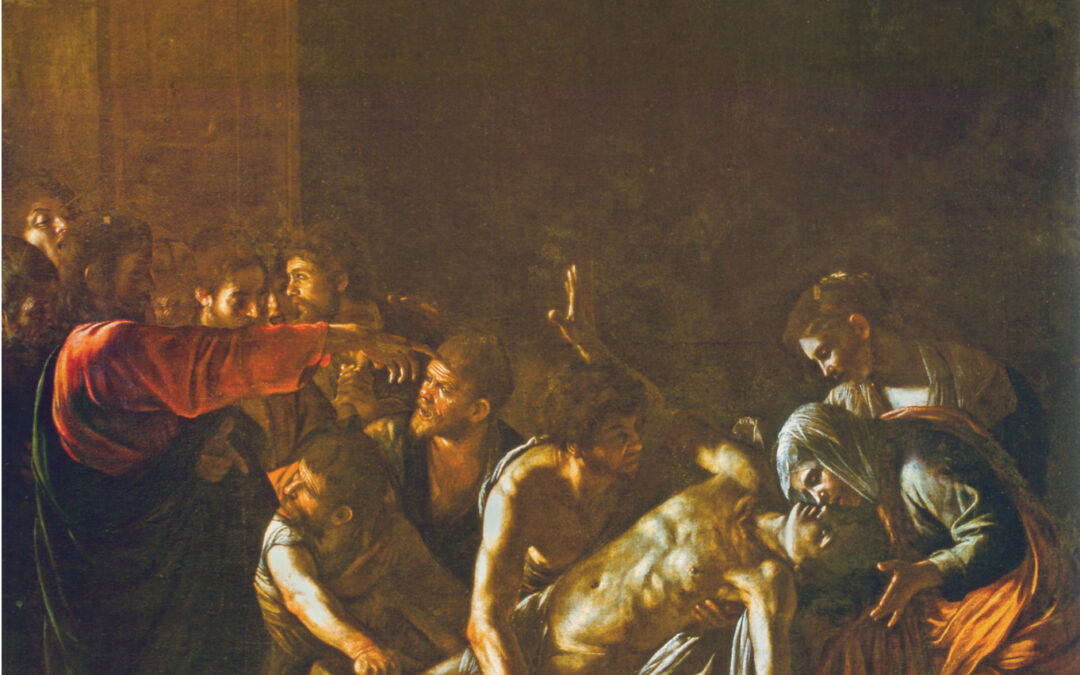
(Michelangelo Merisi da Caravaggio, Resurrection of Lazarus, Regional Museum, Messina, 1609)
Sunday, 22 March 2026
FIFTH SUNDAY OF LENT – YEAR A
Commentary on the Sunday Gospel
Jn 11:1-45
The journey towards the Lord’s Easter continues. The fifth Sunday of Lent offers us a preview of the central theme of Easter: the resurrection. We are in the heart of John’s Gospel, in the episode that marks a definitive turning point in the events of Jesus’ life: this miracle is truly ‘for the glory of God’, in the sense that it will lead him to be glorified from the top of the cross.
On closer reading, we see that the recipient of the miracle is not Lazarus, who comes out of the tomb but is destined to return to it. The womb of Mother Earth that welcomes his body will take him back after a few months or a few years, it makes little difference. We can be the recipients of this miracle if we choose to behave like certain characters in today’s story. It is a wonderful, very dynamic passage in which everyone goes out, from Jesus leaving Galilee to Martha leaving her house, from Mary running to meet Lazarus coming out of the tomb to the Jews leaving the city. Everything is in motion, a sign of life responding to the temptation of death.
‘Lord, the one you love is sick’. The passage opens with a repeated expression of illness. A condition that unites us all; ultimately, all creation is sick, and who among us does not raise a prayer to heaven, similar to that of the two sisters for their sick brother? But in this prayer there is already something more: there is a relationship of friendship, the one you love, an expression that does not offer Jesus many choices, as he is clearly involved. Where there is friendship, there can be no death.
We always seek meaning in suffering. As already mentioned last Sunday in front of the blind man, in this case too, Jesus offers us an unusual interpretation: ‘This illness will not lead to death‘. He says: ‘Lazarus is dead, and I am glad for you that I was not there’. It sounds almost ironic, as if Jesus’ affection would not even have allowed this death, and he could not have performed a greater miracle.
And here Martha and Mary enter the scene, described as being at the centre of the Jews’ consolations. A sincere gesture of closeness and friendship in a moment of pain. An incredibly human scene. It is Jesus who makes this scene unusual and gives us today’s teaching. As soon as Martha hears of the master’s presence, she leaves everyone and ‘when she heard that Jesus was coming, she went out to meet him‘. Here is the first lesson: listen and go out. Listening to God, even just to his silent presence, even in the midst of grief, is a spark of life. Much more so than the circumstantial condolences of neighbours.
In addition to silence, Jesus offers Martha a word of great strength: ‘I am the resurrection and the life’, far beyond individual daily deaths. The great miracle performed by Jesus is with Martha; he manages to give her consolation that answers her deepest questions, even about the very meaning of death and her pain.
“When she heard this, she immediately got up and went to him“: the same dynamic for Mary, first listening, then resurrection, the verb ‘to rise’ coinciding with the verb ‘to resurrect’. The great miracle that Mary brings about with her faith is to see Jesus “deeply moved.” Mary is touched by God’s tears, by his friendship, by his compassion. This whole part of the passage is marked by images of tears, of people weeping, from the Jews to Mary to Jesus.
The third miracle of resurrection, after the one performed on Martha and Mary, is finally addressed by looking at the tomb, the cave where her brother’s body lies. We will also see it on Easter Sunday, the tomb, in Greek μνημεῖον (= mneméion), which has a root in common with memory (μνημεῖον) and with death and the Moirai (Μοῖραι). It is the concrete sign of the awareness of death that accompanies human life. Through the tomb, men remember the destiny that unites all humans, that is, the ‘humandi’ who are destined to return to humus, to the earth. Memory of our origins: we are all made of earth, and destined to return to the earth. A stone in every tomb therefore separates those who have already died from those who have not yet died. Our entire culture can be based on the fear of death, or on the desire for life that dwells in Martha and Mary.
“So they took away the stone. Then Jesus looked up” while everyone else remained looking at the stone, the element that separates the living from the dead. Fortunately, Jesus looks elsewhere. He seems to be pointing us in a new direction, towards heaven. The first thing he does is thank the Father, which is also a great lesson for us who are always ungrateful. And then, a word of liberation, which is much more than giving life again: ‘Unbind him and let him go’ seems like a phrase addressed to each one of us.
Today’s desire for life is expressed by St Francis of Assisi, who sings: “Praised be You, my Lord, through our sister bodily death, from which no living person can escape. Woe to those who die in mortal sin. Blessed are those whom death will find in Your most holy will, for the second death shall do them no harm” (FF 263).
We wish you a happy Sunday.
Laudato si’!
“The one you love”… How often do we almost take it out on God, as if He were distant from us… It’s lovely to reflect on this, dear Antonio
One wonders what this ‘second’ death is that St Francis speaks of. Thank you, Antonio, for drawing this parallel between Lazarus and the Canticle of Creatures
Ce dimanche, un avant-goût de Pâques, avec une « résurrection temporaire » qui nous fait comprendre, en cette période d’ostension du corps de saint François, le sens de notre vie et la valeur du temps. Seul Dieu sauve.
*”_I am the resurrection and the life*_” – Jn 11:1-45
Lord, revive everything in our lives that is dead.