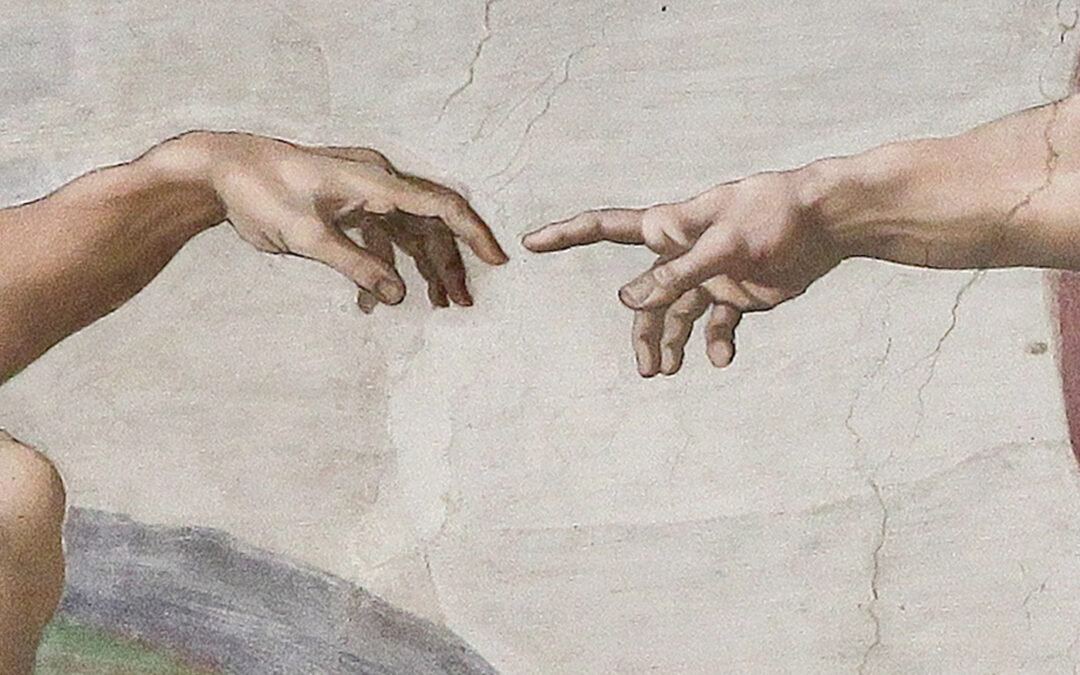
(Michelangelo Buonarroti, Creation of Adam (detail), Sistine Chapel, Vatican City, circa 1511)
Sunday, 4 January 2026
SECOND SUNDAY AFTER CHRISTMAS – YEAR A
Commentary on the Gospel
Jn 1:1-18
Here we are in a new year, on this journey that, step by step, is guided by the word of God, by the Gospel that every Sunday sheds light on our daily lives. This Sunday’s reflection continues that of Christmas, in which we found the same Gospel, the prologue of John. Come to think of it, this is a blessing, because it is such a complex text that perhaps it can be best appreciated in detail twice. Or perhaps twice is not enough, so beautiful and profound is it!
The prologue introduces us to the protagonist of the Gospel: the Word. It is a hymn to the Word, a wonderful poem! What better than a poem to describe beauty, to describe fullness?
As we saw last Sunday, the hymn presents the Word in its relationship with God, in its relationship with creation, in its relationship with history, until the Word becomes flesh, when we see God face to face, as if before a manger full of sweetness and mystery. What is the Word? If we think about it, the Word is what gives existence to every person. Without the Word, man does not exist, does not relate, does not live.
Like an eagle circling, fixing its gaze on its prey even at a great distance, John’s text describes the Word, revealing more and more precise aspects to us as we go along. But in the body of the description, there are interruptions that seem almost out of place with the rest, as in the case of the passages on the Baptist.
In fact, at a certain point, strangely, the hymn interrupts itself on the figure of John, a witness. But the witness is fundamental to the word; without a witness, without communication, there is no word. The Baptist shows us, with his life, one of our duties in view of the new year, one of our commitments: we must bear witness to the light. Witness is not the light! Sometimes we focus only on the prophets, almost deifying examples of virtuous men, but we forget that the light comes from elsewhere, it comes only from God! Everything else is idols. Witnessing is hard, in Greek it is ‘martyrdom’, you give your life for it!
The word is light for every man, beyond religions, beyond cultures and origins. But in the world, this light is not recognised or welcomed. Why do we not welcome it? Why do we know it but not recognise it? To those who welcome it, the power to be children of God is given: the word of truth ‘informs’, makes us like God, makes us God. It is the principle of deification. Everyone is the word they hear, when they become like it.
This word becomes flesh: it changes the economy of the word. How does it become flesh? Man lives by the word, and Jesus lived the word of the Father in his flesh. When we live the word of God, it is as if we begin to live the limits and fragility of our flesh in a divine way, in our relationship with others, in our relationship with creation, in our relationship with the cry of the poor, of the fragile. In my fragile flesh, I can be a child of God if the word of God dwells in me. The cave in Bethlehem that we visited last Sunday is the place that first saw this flesh, this new way for all humanity.
How much light there was in front of those shepherds, who we too can be today, there by chance, at night, in our daily work, in the concerns of life! No one has ever seen God, even though we often make him in our own image, as it suits us best. God is word; you cannot see the word, but you must understand it. The word is narrated through life. The Son, with his life, with his flesh, tells us what God is. The whole life of Jesus, which begins in that cave, is a narration of God. It is an ‘exegesis’, a ‘bringing out’; he exposes us, he explains to us that man is a son, a brother. That God whom we all try to imagine as we please reveals himself to us in humanity, as lived by Jesus.
The most beautiful wish for this new year is to walk with the word of God with the gaze of Francis of Assisi, who said: “And since those who are of God listen to the words of God, we who are in a special way appointed to divine offices must not only listen to and practise what God says, but also, in order to root in ourselves the greatness of our Creator and our submission to him, we must guard the sacred vessels and liturgical books, which contain his holy words” (FF 224).
The destiny of man is at stake in these words. In the light of these words, we can understand all the beauty that God offers us freely every day, and perhaps the new year, in this journey of discovery through his Gospel, takes on a sweeter flavour.
We sincerely wish you a happy new year.
Laudato si’!
Happy Sunday, Antonio, and thank you for this insight into John’s prologue. I believe it is essential to highlight the relationship between Jesus Christ (Logos) and the Creation of the universe. The word that creates, a wonderful key to understanding our everyday present. Happy New Year to everyone!
Grazie Alex, This passage is perhaps the most explicit on the link between Christ and Creation. Everything is created “through” the Logos… How much our Catholic liturgy needs to rediscover this!
Happy New Year and happy journey, following in the footsteps of the Word, beginning with John’s beautiful prologue. Thank you, Antonio, for these weekly reflections.
Grazie Anna, Happy new year
C’est très beau de voir dans le prologue la relation entre quelque chose d’« immatériel » comme la parole, et quelque chose de très concret, comme la création et la vie de Jésus en chair et en os. Ces deux aspects sont tellement liés dans nos vies…
Grazie mille Ben, il est toujours agréable de remarquer ce lien entre le matériel et l’immatériel. C’est à nous de toujours trouver un équilibre dans la vie.
Happy New Year to all of you!