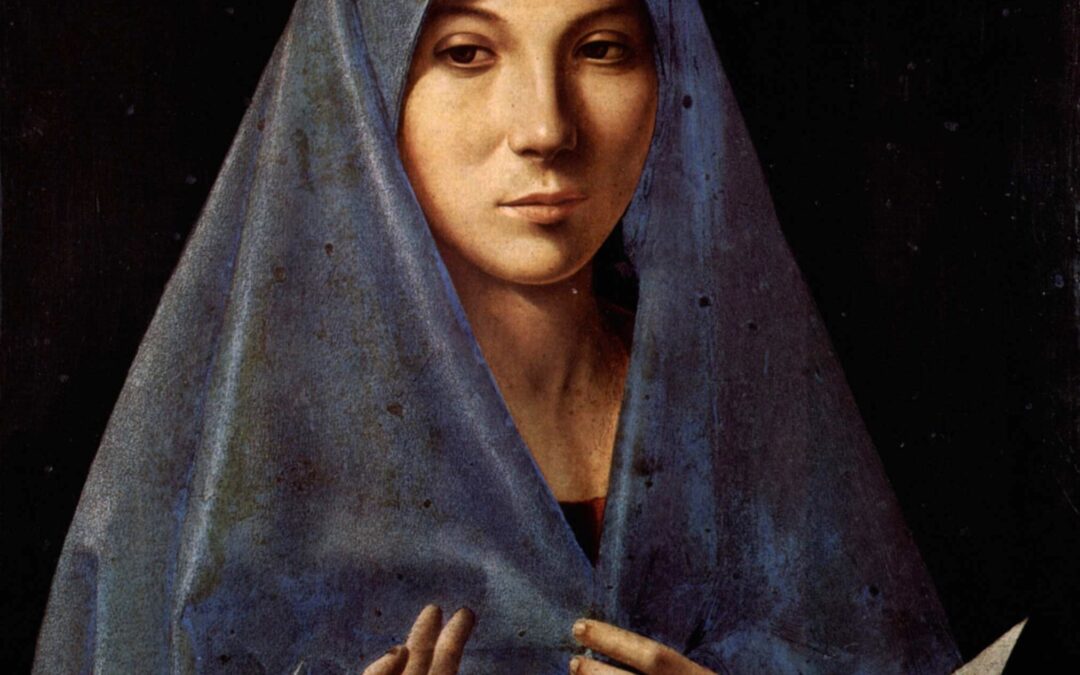
(Antonello da Messina, Annunciata di Palermo, Regional Gallery of Palazzo Abatellis, Palermo, 1475)
Monday, 8 December 2025
SOLEMNITY OF THE IMMACULATE CONCEPTION OF THE BLESSED VIRGIN MARY – YEAR A
Commentary on the Gospel
Lk 1:26-38
On the Advent journey towards the Lord’s Christmas, with the solemnity of the Immaculate Conception, we enter into the intimacy of a home. The scene of the Annunciation offers us an excellent opportunity to prepare our hearts for the Christmas scene we will experience. Like John the Baptist, who is an icon of our witness, Mary is an icon of humanity at the service of the Word. Humanity which, despite being very humble, is clothed in immense glory by God.
Today’s passage is perhaps the one that has given rise to most of the prayers and practices of Catholicism: from the Hail Mary and the Holy Rosary to the recitation of the Angelus to the sound of bells three times a day, as intuited by St Francis; in morning and evening prayer, at midday, and in Ignatian spiritual exercises, this passage from the Gospel of Luke is always remembered. But as with most well-known works, from music to painting, this text too risks being worn out by our habit.
Today’s scene belongs to a diptych; it is the second part of the Annunciation to Zechariah. While the first part takes place in Judea, in Jerusalem, this one takes place in Galilee, in an unknown city; the first part takes place in the temple, or rather in the sanctuary of the temple, the second in a humble house; the first announces the last of the prophets, the second the fulfilment of the promise of Israel. Dante, intertwining the figure of Mary with God the Creator and with all creation, describes Mary in sublime form as follows: ‘Virgin Mother, daughter of your Son, / humble and high above all creatures, / fixed term of the eternal counsel, / you are she who ennobled human nature / so much that its Maker / did not disdain to become her creation. / In your womb, love was rekindled / through whose warmth in eternal peace / this flower has thus blossomed” (Paradiso XXXIII, 1-9).
Mary’s yes allows for a new creation. It is placed at the beginning of the Gospel because it is a prototype for all of us of true discipleship, of those who listen to the word that allows God to be generated in the world, as being the mother and brother of Jesus. This yes takes place “in the sixth month” after the conception of John the Baptist, when the promise is not yet ripe. The sixth month, like the sixth day of creation, is incompleteness, and adherence to God’s plan, which depends on our freedom, can bring the incomplete to completion. Each of us, too, today, can say yes; there is no need to wait for an indefinite future. We need only open our eyes, watch as we were asked to do at the beginning of Advent, and realise that there is a Gabriel, גַּבְרִיאֵל ‘strength of God’, who allows the word to work in the world.
The rabbis said that God created the world with the letters of the alphabet, and by combining all the letters we can obtain the whole world. Everything is ultimately intelligible if we discover the codes for reading it. This creative word comes from outside. ‘Entering through her’, the angel can speak, and at the end of the story, ‘he departed from her’, as if to say that our daily life is touched for a moment and then lives on the fruit of this encounter. The first word that comes to Mary is Χαῖρε, ‘rejoice’, the same root as κεχαριτωμένη ‘full of grace’, to a woman εὗρες γὰρ χάριν ‘because you have found grace’. When God reaches us in our home in Nazareth, he asks us first of all to be happy. Laudato si’!
Mary’s precious turmoil makes us understand that God was unexpected. In our lives, if we are not filled with pride, it is normal to feel inadequate. Hearing that “God is with you” can lead to serenity on the one hand, but on the other, to a sense of vertigo and inadequacy. This is why the first consolation for Mary’s turmoil is the invitation to ‘do not be afraid’ and the promise that ‘you will conceive, give birth and name the child’. The new creation, made possible by the yes of human beings, is a response to the no of Adam and Eve. Let us return to the Garden of Eden, where we can hear God the Creator inviting us to cultivate and care for the earth.
This garden is possible on earth even despite its limitations, ‘I do not know man’, by opening our eyes around us and learning to read the signs of the times, ‘And behold, Elizabeth, your relative, in her old age…‘. Saying yes requires dialogue, discernment, and searching, even if many points remain unclear and God’s plan is ultimately incomprehensible.
“Behold the handmaid of the Lord.” Mary, in fact, defines herself as δούλη, that is, slave, even if for us this term is a little too extreme. In reality, it is much more beautiful, because while the servant performs tasks for the master, the slave belongs totally to the master: Mary accepts to be “totally his.”
Let us pray to the Lord that on this Sunday he may help us to live the newness of the Incarnation with true devotion, in the words of St Francis of Assisi, inspired by the muezzins who marked the days in the East in the 13th century, who said: “And you must proclaim and preach his glory to all peoples, so that at every hour, when the bells ring, all the people may always give praise and thanks to Almighty God throughout the earth” (Letter to the Custodians 1:8).
We sincerely wish you a happy Feast of the Immaculate Conception!
Laudato si’!
Thank you, Antonio, for this reflection that allows us to see Mary in a special light, linked to creation. Happy feast day to all!
Merci pour cet enseignement sur l’immaculée Conception, cheminée vers Noël avec maman Marie c’est une certaine liberté et assurance de cet amour maternel donc elle nous a toujours fait grâce. Bonne fête à nous tous 🙏🏿🙏🏿🙏🏿😘
Mary is the prophetess who gave birth to the great prophet. Her “Yes” brought about our salvation.
The earth would be a better place if we obey in his message for man to save creation.
laudatoSi.
Merci beaucoup
Thank you vers much. Mary, mother of men, mother of God, mother of humanity, the second Eve who knew how to say yes to God. Let us imitate his example in creation by arranging our common home and protecting it. Happy feast of the Immaculate Conception to you to Brother. Nice Day.🙏
Gracias