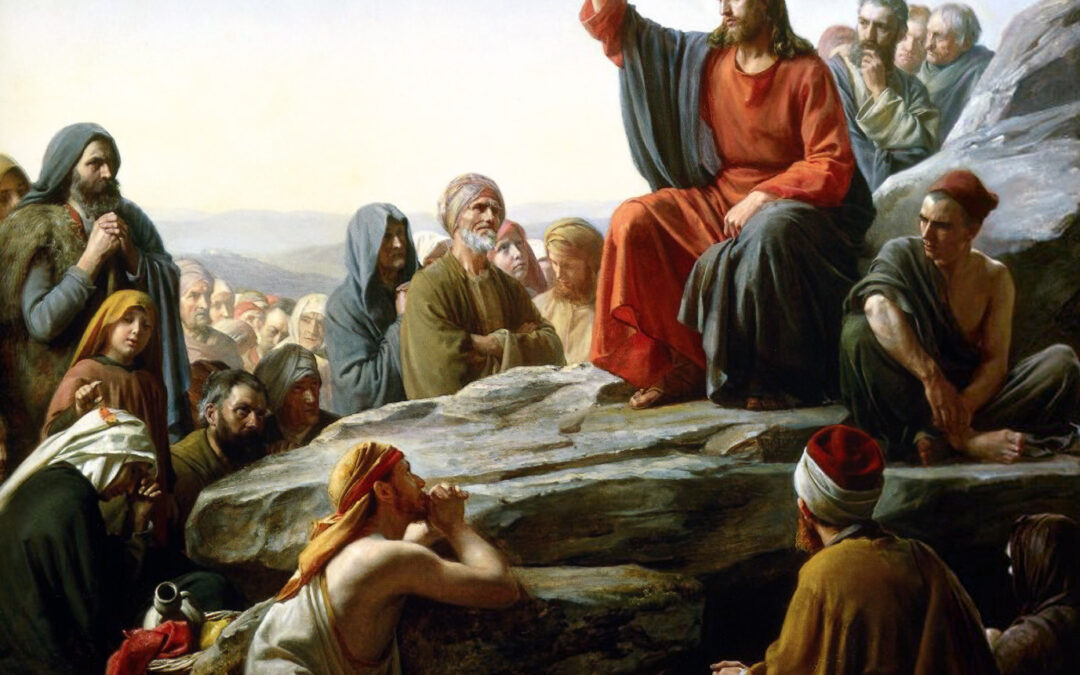
(Carl Heinrich Bloch, The Beatitudes, Frederiksborg, Hillerød, 1877)
Sunday, 15 February 2026
SIXTH SUNDAY IN ORDINARY TIME – YEAR A
Commentary on the Sunday Gospel
Mt 5:17-37
Let us continue on this beautiful journey, focusing our attention on the verses of the Word that the liturgy offers us this Sunday. We are still in chapter 5 of Matthew, the famous Sermon on the Mount, which opens with the Beatitudes, which we saw last Sunday centred on the images of salt and light. Now, through antitheses, Jesus confronts us with our preconceptions, our popular culture, our laziness in thinking as we have always thought, and the temptation to say that everything is wrong.
Matthew addresses the Jews, and this passage is very important in Christ’s teaching because it strikes a balance between these two extremes: conforming out of laziness or destroying everything out of pride. Where do we stand with our traditions? We have always understood that it was said… But what about us? Do we continue to do so, or do we limit ourselves to criticising? Jesus brings a word of light, announcing, ‘But I say to you’.
‘I have not come to abolish’, Jesus is quick to tell us. The temptation is to abolish, to destroy everything that has been done before, in the Jewish tradition as in our parishes, in our dioceses. A temptation to ‘novelty’ that arises from destruction. How difficult it is to be humble of heart like God, who always seeks to build relationships, to repair rather than to buy new things. How much we need this healing word!
The opposite of abolishing is ‘fulfilling‘. It is living that law, embodying a message in the world. The greatest revolution is not to invent new things, but to humbly put into practice a command that comes from God. Going to the root of the command, not to obey out of precept or appearance, but with sincerity of heart. The sincerity that makes St Francis say ‘Laudato si’ without using words. Because words are often not sincere.
The key to these antitheses that we find today is perhaps precisely the sincerity of the heart, the search for justice: ‘unless your righteousness surpasses that of the scribes and Pharisees, you will not enter the kingdom of heaven‘. Scribes and Pharisees are a striking example of meticulous observance of rules, laws, the law. There is nothing wrong with observing the law; it is clear that it is right not to kill, not to commit adultery, not to swear falsely. The rule comes from God! But the crux of the matter is how we observe this law. And here everything changes, if we want it to.
The expression “But I say to you”, which appears four times today, does not indicate that something new is being proposed, but simply a more sincere way of obeying. It is not enough, therefore, to “not kill” and feel good about ourselves. We may not have murdered anyone, but how many people have we slaughtered with our tongues, our prejudices, our lack of charity? And we do not even realise it. How often are we deaf to the cry of the poor, and indeed judge them?
The way to obey is in our relationship with others. Entering into the heart of another is the great revolution to which Jesus invites us. It is not enough to ‘not commit adultery‘ if our eye is unhappy and always desires what it does not have, without praising God for the daily gift that fills our lives. Here too, sincerity of heart makes us reflect on our relationships.
If our relationships are pure, if our heart is pure, we live the beatitude with which chapter 5 opens. Observing the law, in this case, does not become an obligation, but a beautiful consequence. If the heart is pure, there is no need to ‘swear falsely’, there is no need to swear at all. How wonderful it would be to live every day with this lightness that makes us truly free. God’s law is a law that liberates!
On this Sunday, may the Lord give us the gift of being the fulfilment of his Word, becoming faithful men, as St Clare of Assisi suggests: ‘Yes, because it is now clear that the soul of the faithful man, which is the most worthy of all creatures, is made greater than heaven by the grace of God. While, in fact, the heavens with all other created things cannot contain the Creator, the faithful soul, and it alone, is his dwelling place and abode, and this only because of charity, which the wicked lack. It is the Truth itself that affirms this: “He who loves me will be loved by my Father, and I will love him; we will come to him and make our home with him” (FF 2892).
We wish you a happy Sunday.
Laudato si’!
There is nothing newer or more beautiful than the Gospel of Jesus. We find everything we need in it to go to Him without having to fill ourselves with useless and meaningless things.
Nothing disturbs me, nothing frightens me; God alone is enough for me.
What struck me in this reflection is about obidence to the law. It is not enough to obey a particular law and remain there. There are other good things we can do to help make the law effective.
“Do not kill” says the law. Does our actions support this law? We are not killers but are we savers of life?
My take here, is for us to partake in things that will help prolong lives. Let us help to nurture all that God has created so that the world will be a better place to live in.
Merci pour cet enseignement très édifiant, qui nous rappelle une fois de plus que Dieu est amour, le suivre ne doit pas être une contrainte, mais un appel, une relation libre de coeur à coeur pour une vie de plénitude et de bonheur. Bon dimanche à tous
Antonio: muchas gracias por tu regalo dominical con esa relevante columna de fe y generadora de pensamientos y actos!!. Me has ayudado mucho a reflexionar, construir y hacer construir caminos de reencuentro con la fe!!. Un gran abrazo. Espero tu próxima columna.