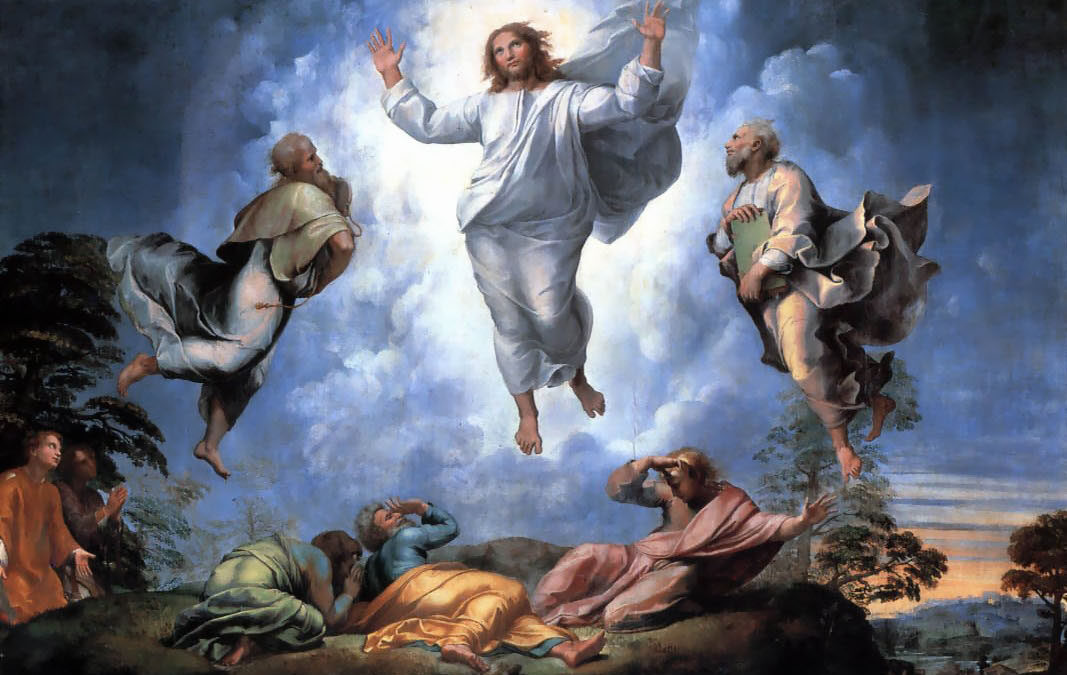
(Raffaello Sanzio, Transfiguration, Vatican Pinacoteca, Rome, 1518)
Sunday, 1 March 2026
SECOND SUNDAY OF LENT – YEAR A
Commentary on the Sunday Gospel
Mt 17:1-9
This Sunday, the Lenten journey towards the Lord’s Easter continues, climbing the mountain with Jesus. What does the transfiguration of Christ mean in our lives? If we think about it, our whole existence is a search for the face of God. How much desire, in men and women of all times, have lived with this desire! From Adam onwards, the one who hid from God’s face, men live between the fear of seeing God’s face and the desire to say with Peter, ‘He is beautiful!
In today’s Gospel, we hear the Father’s confirmation. The voice from heaven testifies to the disciples that he is indeed ‘the Son of Man’, the one who must suffer, and God invites everyone to listen to him. The theme is not the Transfiguration; in fact, Matthew himself does not even use this term. This scene on Mount Tabor is the culmination of God’s creative action. We can say that it is the fulfilment of creation. In fact, ‘all creation groans and suffers the pains of childbirth until today […] waiting for the adoption as sons, the redemption of our bodies. For in hope we have been saved’. (Rom 8:22-24). By contemplating the beauty of this face, it is as if all creation has completed this journey of desire animated by hope.
“At that time, Jesus took Peter, John and James with him”, as often happens in the Sunday Gospel, we lose the temporal setting of the passage. In reality, the passage we find in the Bible tells us “About six days after these words, Jesus took with him…” these words, in which Jesus said that he is “the Son of Man” and will have to suffer to bring life.
He takes them with him, into his intimacy, and leads them up the mountain, to the heights of creation, a place of wisdom and prayer. The true place of transfiguration is prayer. We can only change the world if we learn to “change the world”, to change our gaze, to educate ourselves in our Monday, in our everyday life, in this contemplation.
Unable to describe the face, which is ‘other’, he describes the robe, which is dazzling, and he describes it through two figures, Moses, the expression of the law and the word, and Elijah, the prophet who shows God’s action in history. Only he is the light that illuminates our faces; if we are with God, our faces will be ‘resplendent’. Neither Moses nor Elijah saw death, the former because he received a kiss from God, the latter because he was taken away in a chariot of fire. To understand the glory of God, we must turn to the Bible.
While Moses and Elijah ‘were talking with him’, Peter makes a curious and very beautiful intervention. There is a moment of dialogue between Moses and Elijah with Jesus. The disciple’s first reaction is amazement, ‘how beautiful!’, which, when you think about it, is the exclamation that God makes every day during creation, when at the end of each creative act he always exclaimed ‘how beautiful!’. He says, ‘Let us make three tents’, which seems to foreshadow the habit of building cathedrals. The tents in Hebrew שְׁכִינָה (= ‘Shekhinah’) refer to the tabernacle, the place where the Eucharist is kept. The definitive tent is the flesh of Jesus. God responds through creation, through ‘the cloud’, a sign of life, of rain that quenches thirst, of light in the night of the exodus, of a screen that allows us to see the sun, a sign of God’s love.
God cannot be seen in the cloud; in the first commandment, God says not to make images of him. And in fact, only a voice is heard: ‘This is my Son, the chosen one; listen to him!‘. In listening to him, we find the answer to our desire. While the face is destined to change, and with the passing of the years we risk not recognising long-time friends or relatives, the voice remains the same, the words transcend time. God is voice. With his voice he creates, with his voice he seeks, and man, if he flees like Adam, flees from his voice. Last Sunday, Lent began in the desert, shortly after hearing a voice from heaven saying, “You are my son,” addressed to Jesus, who silently accepted our limitations. Now, however, that voice is addressed to us, quoting Isaiah when he describes the servant of Yahweh (Is 42), saying, ‘This is my son’. Only on these two occasions in the Gospel do we hear the voice of God, and it is curious to see how, in both cases, it says the same thing. How does the Transfiguration end? With listening.
‘When they looked up, they saw no one but Jesus alone‘. The solitude of Jesus, with the cloud and the company of Moses and Elijah gone, brings us back to the everyday reality of the journey. We must listen to the Jesus of the cross, the one who had said shortly before that we must suffer, not the Jesus of glory.
This beauty that shone on Tabor seems to be sublimely described by the words of St Francis in his paraphrase of the Our Father: “O most holy Father of ours: creator, redeemer, comforter and saviour of ours. Who art in heaven: in the angels and saints, enlightening them with knowledge, because thou, Lord, art light; inflaming them with love, because you, Lord, are love; dwelling in them and filling them with bliss, because you, Lord, are the highest good, eternal, from whom all good comes and without whom no good exists.” (FF 266-267).
We wish you a happy Sunday
Laudato si’!
Happy Transfiguration Sunday to all of you!
Seigneur, aide-moi à te voir transfiguré dans mes frères et sœurs, et dans toute la création.
” *_Be perfect, as your heavenly Father is perfect_* ” — Mt 5:43-48
Lord, deign to raise us to perfection through obedience to your commandments and love of neighbor.