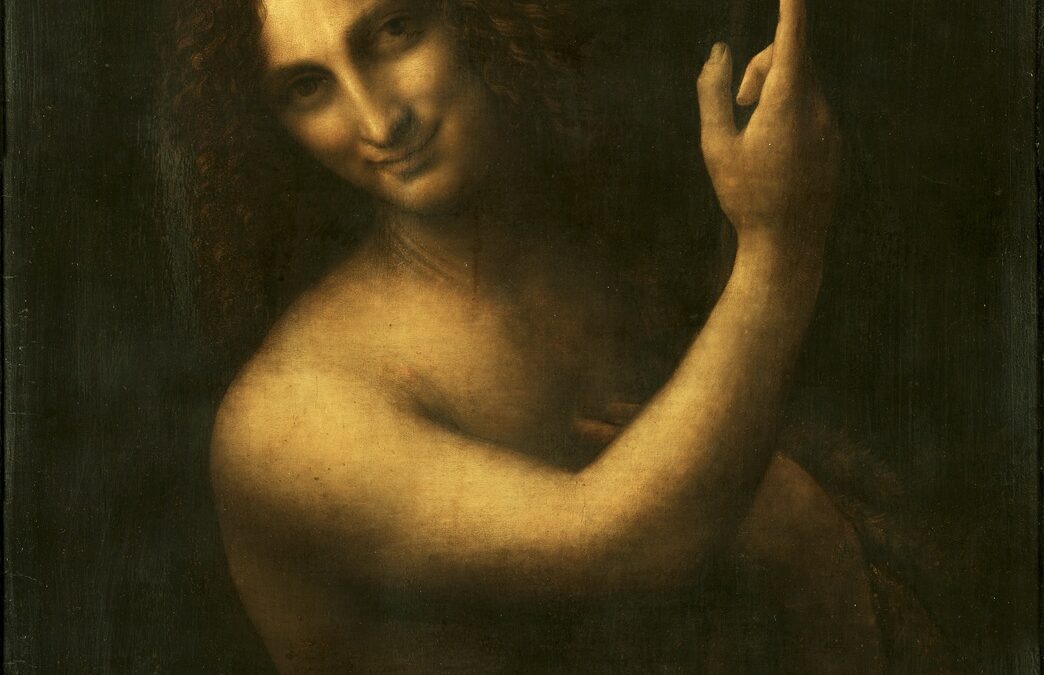
(Leonardo da Vinci, Saint John the Baptist, Louvre Museum, Paris, 1508)
Sunday, 7 December 2025
SECOND SUNDAY OF ADVENT – YEAR A
Commentary on the Sunday Gospel
Mt 3:1-12
The Laudato Si’ Journey continues, accompanying the Sundays of the liturgical year. This Sunday, the Gospel presents us with the figure of John the Baptist, an icon of the person who approaches the newborn God. It is interesting to see how he is the last prophet, a link between the Old and New Testaments.
How much we need prophetic people and gestures! The whole of Jewish culture has been imbued with God’s promise, the land and the descendants, since the time of Abraham. There is no law without prophets. A prophet is not someone who predicts the future; those are fortune tellers or charlatans. Rather, even today, prophets help us to read the present, to understand the life around us in the light of God’s word.
This Sunday’s Gospel takes us by the hand to discover this God who, by becoming incarnate, chooses the path of self-emptying. A path of kenosis, of removal, as good sculptors do, who create with gestures of subtraction, of humility.
‘In those days, John the Baptist came’. Today’s passage begins with this temporal expression, which is used every Sunday to open the Gospel passages. In Matthew’s text, this expression indicates an event that happened and can be relived to the extent that we desire. Those days can also be our days, if we want them to be. The Baptist, the one “who baptises”, who immerses deeply, who helps us to know deeply, preached. Or rather, he proclaimed, he shouted an important announcement to everyone: the Kingdom of God is here!
Nothing to preach or explain, but a brief and shouted announcement. An announcement that takes place in a particular place, in the desert. Here, creation speaks to us through places that express our history: the desert is the place of the Jewish people’s escape from slavery, but it is also a non-place because it is not the destination of the journey, and because it is not a safe and desirable place. It is an invitation to dynamism, to walking, because if you do not walk, you die in the desert. Deserts, both internal and external, are the places of our daily lives, the places of our fears, our temptations, our idols and our golden calves. They are the places where we experience God’s providence, where we find manna and quails, where we recognise our fragility and our trust in the Creator.
‘Repent!’ is the urgent proclamation of John the Baptist. Change your ways, you are doing everything wrong, he seems to be telling us. It is not a pleasant message when someone reminds us that we are doing everything wrong! Let us think of Pope Francis, his call to conversion to integral ecology, how much we need conversion! And how difficult it is to be understood, to be listened to. Let us convert today, as we said last Sunday, today is the kairos, the opportune moment. We must not wait for the future, we just need to turn our gaze, convert, and the kingdom of God is here.
The Baptist is an icon of the prophet. He is first and foremost a ‘voice’, distinguished by his cry in the desert, quoting another prophet, Isaiah. He dresses in ‘camel’s hair and a leather belt’ like Elijah, eats ‘locusts and wild honey’ like a hermit. The camel is the animal that lives in the desert and allows one to cross it. The Baptist is clothed in the word of God that quenches thirst in the desert. The locusts in the desert killed the serpent, the word that kills lies. In him, one experiences, in an integral way, from his voice to his clothing to his food, the power of God’s word that nourishes and gives life.
People leave “Jerusalem” to rush to him, to be baptised and confess their sins. A reverse exodus, the promised land is no longer Jerusalem, but everyone feels the desire to leave the city. How many times in life do we chase after so many ‘Jerusalems’, only to discover that the encounter with God, in the depths of water and forgiveness, is found elsewhere, in creation and in our relationship with our brothers and sisters! Even if we encounter a harsh message, which speaks to us of an axe ready at the root of the trees, and of a fire that purifies from evil and judges.
Let us pray to the Lord that on this Sunday he may help us to live with prophetic courage, in the words of St Clare of Assisi, who said: ‘Yes, for it is now clear that the soul of the faithful man, which is the most worthy of all creatures, is made greater than heaven by the grace of God. While, in fact, the heavens with all other created things cannot contain the Creator, the faithful soul, and it alone, is his dwelling place and abode, and this only because of charity, which the wicked lack. It is the Truth itself that affirms this: ‘He who loves me will be loved by my Father, and I will love him; we will come to him and make our home with him’.” (FF 2892).
We wish you a blessed Advent Sunday!
Laudato si’!
Thank you, Antonio, for this reflection, which brings us into the humble spirit of Christmas. My wish is that we follow the teachings of John the Baptist, to better prepare ourselves for this event. Have a good Sunday.
La rencontre avec Dieu se trouve dans la création, dans nos relations avec nos frères et sœurs, c’est le message que je méditerai et partagerai autour de moi cette semaine. Merci Antonio pour ces enseignements qui nous éclairent
Grazie Mark, have a blessed Advent season!
I like it when you say: “It is an invitation to be dynamic, to walk, because if you don’t walk, you die in the desert.” The desert forces us to move, to question ourselves, to search. May this be a Christmas of searching for all of us.
Grazie Matthew, may this truly be an Advent of movement and discovery for all of us. Have a good journey!
Beautiful reflection! I especially loved this comparison of kenosis and sculptors and the invitation of gestures of subtraction and of humility. Thank you!
Grazie Christina, Michelangelo sculpted by removing material, literally “per via di levare” (“by taking away”, and ultimately this is God’s way of creating, by taking away… Forward on this path of kenosis, towards the cave in Bethlehem.