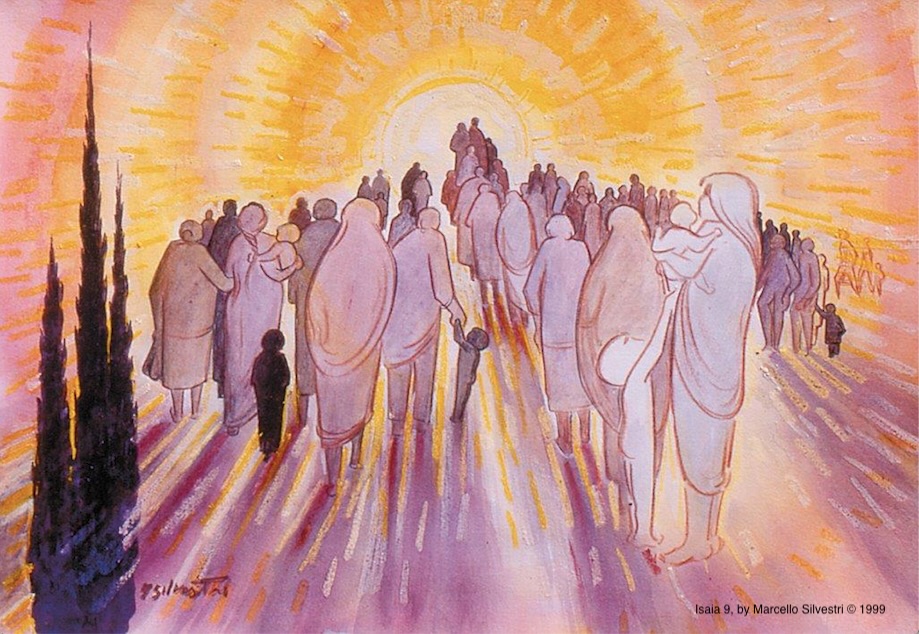
(Marcello Silvestri, Beatitudes, Private collection, Tarquinia, 1999)
Sunday, 1 February 2026
FOURTH SUNDAY IN ORDINARY TIME – YEAR A
Commentary on the Sunday Gospel
Mt 5:1-12a
Today’s journey through the Sunday Gospel offers us one of the best known, and perhaps one of the most beautiful and dramatic, passages from Matthew’s Gospel. We are in chapter 5, and the setting changes from the desert to the mountain.
This is a solemn discourse, probably repeated every time Jesus and his caravan visited a new village. It is a teaching addressed to the crowds, but also to the apostles, who listened to these words each time and engraved them in their hearts. Creation has a fundamental value: we are not ‘on a mountain’, but ‘on the mountain’, in the place that brings us closer to God, in the place of toil and contemplation of beauty. A discourse that unfolds through eight beatitudes, which are perhaps the most beautiful portrait of Jesus, because he is first and foremost the poor, he is the one who weeps, he is the meek, the hungry for justice, the merciful, the pure of heart, the peacemaker, the persecuted. The eight beatitudes are perhaps the portrait of each of us, the wish to follow our teacher Jesus. It is a dramatic passage, precisely because it risks making us understand how far we are from the words of Jesus.
‘At that time, seeing the crowds, Jesus went up the mountain’. It is a solemn beginning, with a measured pace, an introduction to the discourse marked by clear actions, by a rhythm. Jesus sees the crowds, the same ones he healed a few verses earlier as he walked along. Then ‘he sat down and his disciples approached him’. His seated position reminds us that he is the teacher, and we, if we want to be like his disciples, must approach him. “He began to speak and taught them, saying,” he opens his lips after we have followed his actions with our eyes, it almost seems as if we can still hear the silence that will be broken by the wisdom of Christ.
A consideration on the term “Blessed” which resounds eight times, in addition to the dedication to his own. A word that sounds like a mockery, if understood in its meaning of “lucky you!” There is little to envy in a poor person, a hungry person, a sad person, so why tell them that they are “blessed”? Perhaps we are so used to reading these words at Mass that we are addicted to this oxymoron! But the discourse unfolds between the terms ‘blessed’ and ‘because’. Each ‘because’ reverses the meaning of blessedness, completes the meaning and offers dignity to the poor, the hungry and the meek. We can say that ‘they are blessed because’. Our blessedness lies in an opportunity, not in a momentary condition.
The first blessed are the ‘poor in spirit’, the poor understood as πτωχός (= ‘beggar’), that is, those who have nothing, a word close to the meaning of hiding, people who hide their faces, invisible. How many poor people populate our cities! For God, as understood by Francis of Assisi, having ‘nothing of one’s own’ is a value. The value of dispossession. God, with a gesture of kenosis, dispossesses himself, creates, puts himself at the service of his brothers and sisters, washes their feet. They are ‘in spirit’ precisely because they are humble, because one can be poor but arrogant, and that is not blessedness.
Then there are ‘those who mourn’, who are blessed now not because they are afflicted, but because ‘they will be comforted‘. The consolation that comes from God, who is the Paraclete, the comforter. We can experience bliss today for what we will receive from God in the future. Between the present and the future lies our journey towards God. In this sense, even ‘the meek’ are blessed today, because from God ‘they shall inherit the earth’. The opposite of the meek is the arrogant, those who take possession of the earth and do what they want with it, destroying it and using it according to their needs. Behold, the beautiful promise of blessedness is that the earth will not belong to the arrogant, but to those who silently care for it, even losing their own pretensions.
Blessed are “those who hunger and thirst for righteousness,” not human righteousness, but charity and sharing. How great is our hunger for sharing, how often do we experience a sense of “injustice.” Just as those who put their heart into looking at their brother, “the merciful” (from the Latin “misereor” = I have mercy and “cor – cordis” = heart), who suffer for the pain of their brother, will receive the gift of God’s heart! And blessed are “the pure in heart”; how wonderful it is to meet people with pure hearts. Often our hearts are cloudy, a mixture of feelings, a puddle of mud. Instead, when a heart is clear, it allows us to ‘see God’, to recognise him in his creation with the immediacy of children.
The last two beatitudes are somewhat complementary, because both “peacemakers” and “those persecuted for righteousness’ sake” are very similar categories: those who seek to bring peace ultimately want to reduce inequalities and wars. From this we understand the last beatitude, addressed specifically to the apostles, to our beloved Church: when we receive all that is contrary in the world, insults, persecution, lies, malice, slander, because of him, then there will be ‘perfect joy’, there will be joy and dancing. It is a warning to the Church, not using the present tense as in the eight beatitudes, but the future tense. And our reaction, in order to conform to our master, will be to dance!
On this Sunday, may the Lord give us the gift of living the Beatitudes, as beautifully summarised by Francis of Assisi in the Canticle of the Creatures: “Blessed are those who will sustain him in peace, for they shall be crowned […] Blessed are those whom he shall find in his most holy will, for death shall not harm them” (FF 263).
We wish you a happy Sunday, accompanied by the word of the Lord!
I like to read the Beatitudes as a portrait of Jesus. St. Francis, who wanted to be “another Christ,” understood what it means to be holy… To be blessed…
Thank you, Ben. When we learn to have Christ as our only model for life, then we will be within the beatitudes.
Gracias Antonio, gran enseñanza nos dejó Jesús en las bienaventuranzas.
Las aprovechemos y llevemos a la práctica. Saludos
How many “beggars,” as you call them, are there in our cities, how many invisible people. How many of them can we say are “blessed”? The word of God is always difficult to live by and understand.
Thank you, James, for your comment. We must learn to understand God’s language. As long as we see the poor as a scandal, we have a long way to go…
*Gospel according to Saint Matthew 5:1-12a*
Lord, in the silence of my heart, I stand before you and let myself be pierced by your loving gaze. Teach me to remain in your presence.
Lord, make my heart poor, meek, and merciful, yearning for justice and peace. May I humbly follow you on the path of the Beatitudes.
You invite us, Lord, through these eight Beatitudes, to trace a path of life founded on joy and rooted in communion with God. Grant that I may embrace each one step by step with trust.
PEACE BE WITH YOU
ONE PEOPLE ONE LOVE ONE SPIRIT FOREVER
Merci Antonio pour ces réflexions qui nous aident toujours à préparer notre cœur à l’écoute du dimanche. Je ressens fortement le besoin des dernières béatitudes, en ces jours où la paix vacille. Prions le Seigneur d’envoyer de nombreux artisans de paix, même s’ils seront persécutés par la justice…
Dominique, prions pour la paix, partout dans le monde et en nous-mêmes…
I agree with what you wrote. It is not an easy path, but our Friend will not abandon us. We must be certain of that. Thank you again. Laudato Si’.
Merci Antonio, je dirais un phare lumineux, nous sommes et sommes toujours en chemin, et plus on essaie d’atteindre la moitié du chemin, plus il faut se battre !
Merci pour cette réflexion. Je la partagerai demain avec ma famille lors de notre étude biblique. 🙏
Thank you, Antonio.
I feel touched by Grace when I meet people with whom I can share the charisma that has shaped me and accompanies me in every context and situation in life.
I embrace you too🤗