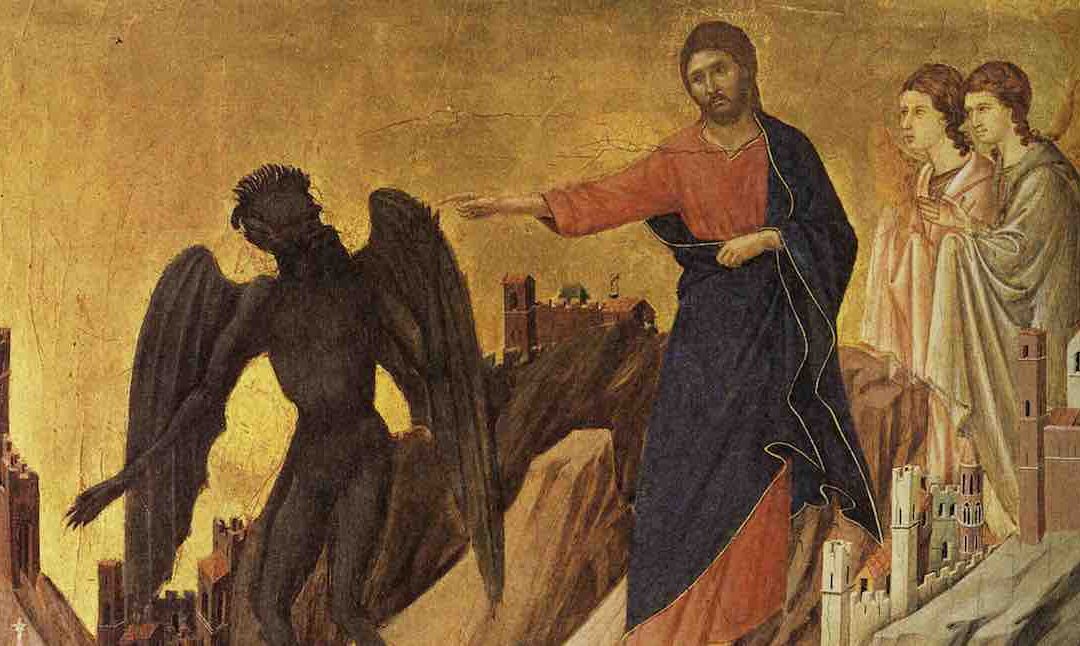
(Duccio di Buoninsegna, predella of the Majesty of Siena Cathedral, Frik Collection, New York, 1308)
Sunday, 22 February 2026
FIRST SUNDAY OF LENT – YEAR A
Commentary on the Sunday Gospel
Mt 4:1-11
This Sunday marks the beginning of a new journey, one that is both old and new, just as our lives are cyclical. Today we enter into the natural context of the Baptism in the Jordan. After his baptism, Jesus is described in the episode of the temptations. It is important to begin this Lenten journey by focusing on the theme of temptation, taking Jesus as our example.
What is temptation? Satan himself gives us the answer: ‘If you are the Son of God‘. Temptation does not concern things, bread, water, because things are in themselves. If we live as children of God, we understand that everything is a gift. But if our god is something else, then we become the masters of Creation, we take possession of it, we delude ourselves into thinking we can dominate it. This is the temptation we all experience: who among us, in order to solve world hunger, would not want to turn all stones into bread? Who among us, looking at international politics, would not want to rule the kingdoms of the earth in order to live in world peace? If we had a god who granted all our desires, the prayers for healing that our friends ask of us, how happy would we be? Come to think of it, this is the temptation we all experience, our church, often ‘for the greater good’.
Jesus categorically refuses, refusing to be the Messiah who solves all the world’s problems. He is not the political Messiah that many in Israel were waiting for. He is not the Messiah with special effects, who comes down from the cross and everyone believes him. None of that. Jesus, as the Son of God, chose to be in solidarity with all his brothers and sisters, with the limitations of each of us, beginning with the silence experienced at his baptism, a few verses earlier, standing in line with sinners.
‘Jesus was led by the Spirit into the desert’, full of the Spirit, having just heard the Father say, ‘You are my son‘. The desert, a place of Creation that speaks to us powerfully through silence and the aridity of death, is the place of our limitations. It is the human condition as opposed to the garden, to wealth, from which Adam fled, ending up in the desert through disobedience.
The word temptation, in Greek πειρασμός (=”peirasmos”), means “pierced with the tip”, “to go beyond”, to find the ford. From this word derives “experience”, also “expert”; in the trial you become tested, you gain experience. The word “danger” also derives from the same root, the root of “perish”. Temptation expresses the tension in our lives, where on the one hand we want to ‘go beyond’, but on the other we continually risk perishing.
“After fasting forty days and forty nights, he was hungry.” This is normal; every man is hungry. Hungry for food, for material goods. Hungry for relationships, for life among men. Hungry for God, for answers that go beyond our daily gaze. The story of today’s three temptations unfolds around these three forms of hunger, which encompass all human desire.
“If you are the Son of God, command that these stones become bread.” On the surface, this seems like a good deed. Bread is good, stones are good, so what is wrong with obeying? The devil does not doubt that Jesus is the Son of God; that would be foolish. But the subtle emphasis of the temptation is “how to live as children of God.” We see that Jesus responds with a quotation from Deuteronomy (Dt 8:3): ‘Man shall not live by bread alone’, and completes it by saying ‘… but by every word that comes from the mouth of God‘. Everything is a gift, and all goods are to be lived as custodians, not as masters. How prophetic is the vow of ‘poverty’ that Francis asks of his friars, to ‘live without anything of their own’.
‘If you are the Son of God, throw yourself down’, the second temptation, no longer spoken in the desert but at the highest point of the temple. The temptation addressed to God, the great hunger of man who needs God. In this temptation, the devil expressly quotes the Word, Psalm 91; the devil knows theology well. The devil quotes the best psalm on trust in God. The invitation is “put God to the test, who promises you this!” What’s wrong with that? The temptation is to put God to the test, precisely because deep down you don’t trust him. If a boy trusts his girlfriend, he doesn’t need to put her to the test.
“All these things I will give you if you will fall down and worship me.” This is what the tempter says in his last attempt, having taken him up to the top of the mountain. Man’s third “hunger” is for power. It no longer concerns things, but relationships with others. He does not say ‘if you are the Son of God’, because it would make no sense to ask him to prostrate himself, but he shows him the kingdoms, power as dominion. Jesus always responds with Sacred Scripture, referring to the scene of the golden calf and quoting Deuteronomy when he replies, ‘You shall worship the Lord your God and him only shall you serve’. There is nothing good, unlike bread, in dominating others. ‘Then the devil left him’. The ending is very beautiful: the devil gives up and goes away. This allows Jesus to be approached by angels who served him. Resisting temptations leads us to be served by God.
In this gratuitousness demonstrated in the desert of temptations, we seem to hear the words of Saint Clare: “The blessed Francis, seeing that, despite the weakness and fragility of our bodies, we had not shrunk from any hardship, poverty, fatigue, or tribulation, nor from the ignominy or contempt of the world, but rather, following the example of the saints and his brothers, considered all these things to be the greatest delight, rejoiced greatly in the Lord” (FF 2832).
We sincerely wish you a blessed Lenten journey.
Laudato si’!
Jesus tells us that we do not need to perform ‘special feats’ to be loved by God. The ‘evil one’ is always on the lookout for our weaknesses so that he can take advantage of them; ‘I will give you everything if you bow down to me,’ he proposes.
This Lent must help me to become a better person, otherwise the teachings of Jesus will be in vain, and that would be a very grave sin.
This is the true great miracle of Jesus: resisting the temptation of special effects. How much we need such a teacher, especially today!
Je vous souhaite à tous un beau cheminement de Carême, à l’écoute de la Parole de Dieu, pour résister aux tentations du monde.
Thank ypu so much for this great inspiración to live this Lent Time as truly son of God.