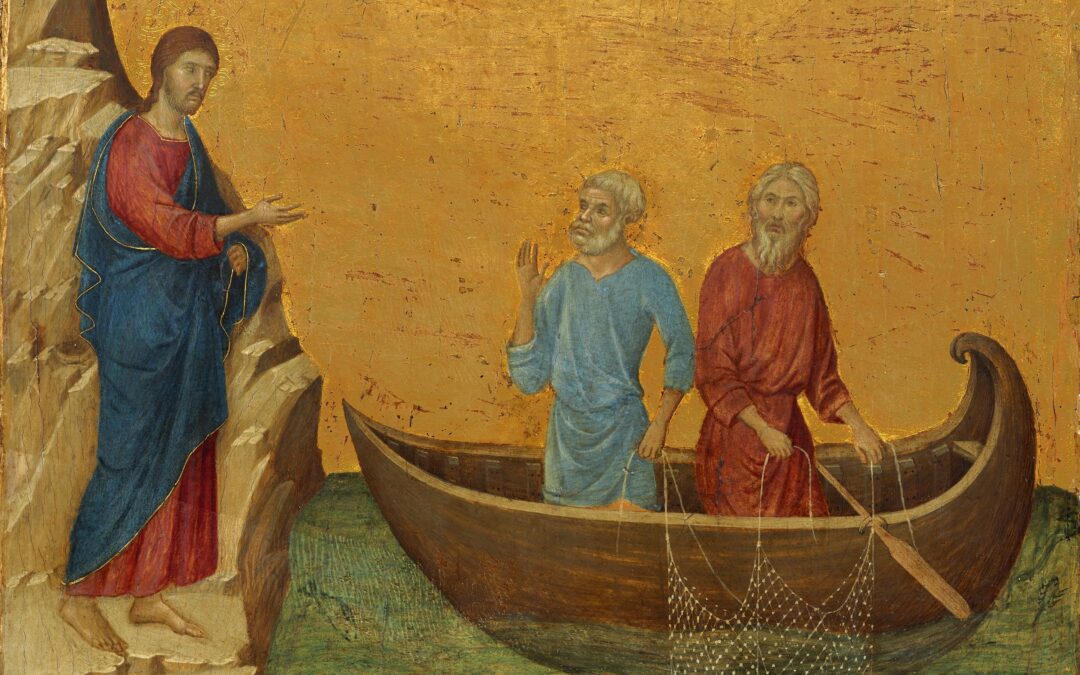
(Duccio di Boninsegna, The Calling of Peter and Andrew, National Gallery of Art, Washington, 1308)
Sunday, 25 January 2026
THIRD SUNDAY IN ORDINARY TIME – YEAR A
Commentary on the Sunday Gospel
Mt 4:12-23
We continue our journey in the footsteps of the Word through this Sunday’s Gospel, which presents us with the beginning of Jesus’ mission and the calling of the first apostles. It is a story that can help us understand what kairos is, the opportune moment to accept the call to conversion and action.
We are in the first chapters of Matthew’s Gospel, after the account of the temptations in the desert and before the Sermon on the Mount. Today’s scene is introduced by an editorial passage, which acts as a kind of hinge between the Baptist – the tradition of Israel – and the Beatitudes – the newness of the Gospel. This is not a ‘minor’ passage, but rather one that sheds important light on the meaning of Jesus’ human story, as described in the Gospel of Levi: thirty years in Nazareth, the last weeks in Judea and Jerusalem, and the heart of the story in Capernaum, by the sea.
‘When Jesus heard that John had been arrested’, literally ‘handed over’, just as Jesus himself will be handed over and betrayed at the end of the story. Paradoxically, this is the kairos to begin the mission: Christ begins precisely when he learns that his prophet is in prison. When you are handed over, betrayed, that is the opportune moment for God: man wants to hand him over, and he hands himself over; man wants to sell him, and he makes himself a gift.
Jesus therefore withdraws, flees, because this too is a kairos: it is not a matter of cowardice, opportunism or calculation, but of fulfilling a mission. Just as the flight into Egypt had allowed the family to take its first steps, this flight allows the first steps of Christ’s mission: in Nazareth Jesus had already been expelled from the synagogue, in Jerusalem he risks ending up like John.
So the ‘land of Zebulun and the land of Naphtali, on the road to the sea’ becomes the ideal place, because ‘Galilee of the Gentiles’ needed light, recalling Isaiah’s prophecy about the oppression of the Assyrian king Tiglath-Pileser III. This is the kairos, the right time and place for each of us. Everyone lives in a ‘Galilee of the Gentiles’ that thirsts for light in its daily life. There is no point in waiting for a different time, an astral conjunction, to begin.
The people ‘lived in darkness’, in a static position, while immediately afterwards it is said that Jesus ‘walked along the sea‘. The link between the mission of Jesus and that of the apostles is given by an attitude of movement. Creation becomes context and opportunity, in the daily routine of work, in its dignity. An opportunity for encounter and salvation. Jesus first preaches, inviting everyone, ‘Repent’, and then calls them by name. The scene seems to repeat itself twice in the same way, but in this redundancy there is a belonging that has been repeated for two thousand years: each of us is called by name, every day.
Each call is similar, but it is not a photocopy: there are slight differences that always make the encounter unique. They are not all ‘fishermen’, they are brothers, they do not all have only ‘nets’: for example, Simon and Andrew do not use trawl nets, but the giacchio, a small net used by poor fishermen; unlike the boat of the sons of Zebedee, with better nets and – as Mark recounts – even with servants. But each one is reached by the same call to action, a call by name. A call to follow Jesus.
The response is in silence, it amazes us: they leave everything. They leave because they find, they find everything, they are found by a gaze that gives life! They are called to do what they already do, to be ‘fishers of men‘. The sea, a sign of death and sin, becomes the place to bring to life, to ‘fish’ for many people in history! In this sense, God comes to dwell in our stories, our talents, our ‘Galilee of the nations’ and fill it with light and meaning. This leads the first apostles to leave everything behind, because they find everything!
Let us pray to the Lord today, on this Sunday, that we may joyfully accept the invitation to conversion proposed by Francis of Assisi, who said in his paraphrase of the Our Father: “Thy kingdom come: that thou mayest reign in us through grace and bring us into thy kingdom, where the vision of thee is unveiled, the love of thee is perfect, the communion of thee is blessed, and the enjoyment of thee is without end” (FF 269).
We wish you a happy Sunday
Laudato si’!
The answer lies in silence. It is remarkable how the most meaningful words that emerge from this Gospel are practical actions, such as the nets left behind in the boat. Thank you, Antonio, for this beautiful insight.
Thank you, Carlos. Today we respond in silence, and God will open new paths!
S’abandonner totalement à Dieu pour une rencontre parfaite avec Lui, le laisser nous transformer à son image dévoile son amour infini pour nous.
Merci pour cet enseignement et très belle semaine à tous
Cet évangile nous rappelle que le moment opportun dans notre vie est souvent le pire, l’échec, ou lorsque nous ne comprenons vraiment rien. C’est là que Dieu construit sa providence.
Nous devons toujours apprendre à trouver des opportunités dans les difficultés. Le lieu choisi par Dieu pour agir
“From that time on, Jesus began to proclaim, ‘Repent, for the kingdom of heaven is near.'” — Mt 4:12-23
Lord Jesus Christ, on this Sunday dedicated to the Word of God, may this word inspire in us sincere conversions to return to the good graces of the heavenly Father.
The Lord calls us in our daily lives, illuminating our everyday existence like a ray of sunshine. It is up to us not to wait, but to respond promptly.
How wonderful to feel this ray of sunshine in our lives. Thank you, John.
Thank you all, on the Sunday of the Word of God, your comments and reflections have placed the word at the center. As in the Jewish feast of the word, we have celebrated spiritually. And every Sunday, we try to place this demonstration of love at the center: God speaking to us. Have a good week!
“Those who sit in darkness has seen a great light”.
Jesus is the light of the world. Each day he invites us to dump everything that holds us back from responding to his call.
The disciples abandoned their boats and fishing nets to follow jesus.
In our daily life, it is important that we move away from distractions and noise to enable us listen to his voice, respond and take action.
Water here represents nature.