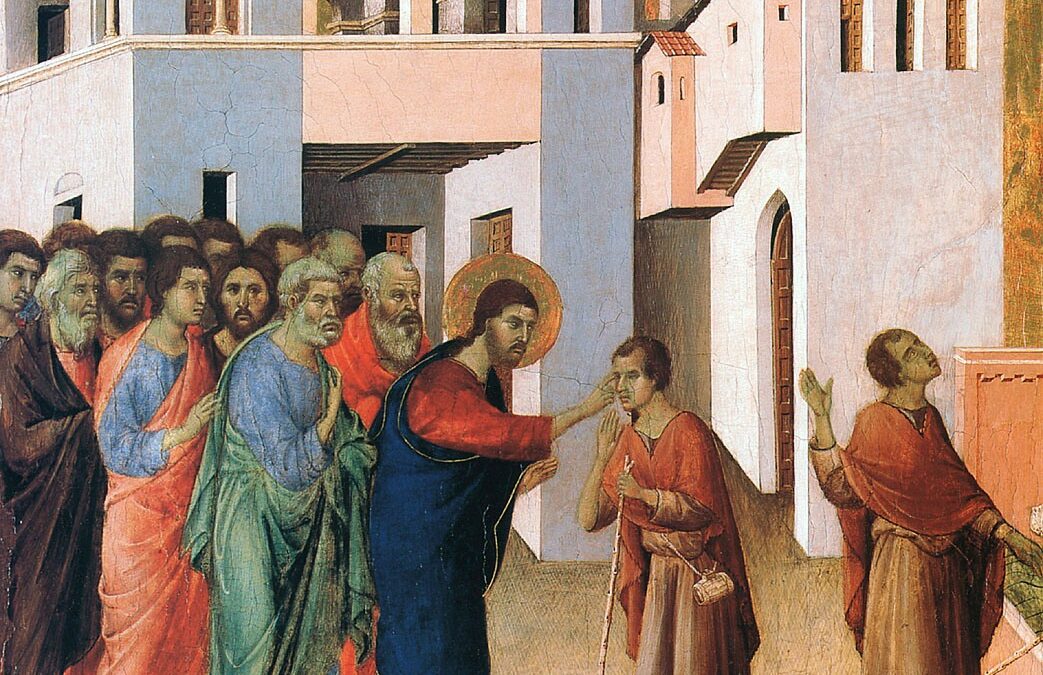
(Duccio di Boninsegna, Jesus Christ Restores Sight to the Man Born Blind, National Gallery, London, 1308)
Sunday, 15 March 2026
FOURTH SUNDAY OF LENT – YEAR A
Commentary on the Sunday Gospel
Jn 9:1-41
The fourth Sunday of Lent, in laetare, even in the liturgical colours we find on the altar, invites us to rejoice, to anticipate the joy of Easter, even as we journey towards the Lord’s Passover. We are halfway through this journey, and today we are presented with a typically ‘baptismal’ passage, with a scene that can be a metaphor for each of our journeys of faith. We witness a new creation, through sister earth and spittle – water and fire of the Spirit – Jesus is as if he were moulding a new Adam ready to contemplate his face.
We are in Chapter 9 of John, in the temple in Jerusalem during the Feast of Tabernacles, where Jesus had spoken about life, death, and the fatherhood of God, risking being stoned by the Jews. Now, still in the vicinity of the temple, Jesus performs another work that refers us to life, to ‘coming to the light’. In fact, it is said that ‘Jesus passed by and saw a man blind from birth’; it is always God who sees man first.
In the disciples’ question, ‘Who sinned?’, there is the question that lies in the heart of each of us, the meaning of suffering. Why is there evil in the world? The retributive Jewish tradition, which we still live by in part, says that if you are blessed by God, things will go well for you in life. To this temptation to devour the planet and the goods of others, Jesus replies: ‘Neither he nor his parents sinned’. Evil is not being poor, blind, or suffering, but evil is stealing, killing, and causing suffering.
“He spat on the ground, made mud with his saliva, and spread the mud on the blind man’s eyes.” Jesus performs three actions, he does not perform a miracle: he spits, mixes and spreads mud. On his own initiative, without anyone asking him to. He shows great delicacy towards the sick man, leaving him the freedom to heal. Elisha’s question to Naam the Syrian returns, or the one Jesus asked the sick man at the pool of Bethesda: “Do you want to be healed?” It is not a given that we all really want to be healed; often our labels and our comfort zones reassure us. Jesus leaves us the freedom to see the light. ‘He went, washed himself and came back seeing’. This, in a nutshell, is what frees this man who was blind from birth. The important things in life are almost always contained in a few moments and gestures.
This man, alone in the temple, undergoes a real trial, which first involves ‘his neighbours and those who had seen him before’, that is, the everyday reality that labels you; then it involves the Pharisees, those who live by prejudice and rigid rules, such as observance of the Sabbath; and finally his parents, who, for fear of the Jews, do not even take a stand. This man experiences the humiliation of loneliness as a reward for the miracle he has received! In all three situations, he simply recalls the facts: Jesus spitting, kneading and smearing.
The final part of the debate with the Pharisees is worth reflecting on. Impatient, the former blind man asks an ironic question: ‘Why do you want to hear him again? Do you also want to become his disciples?’. Irony is the weapon of the weak, often capable of telling the powerful the truth in a crushing manner. Here, the powerful, who even intimidate the parents, respond with insults and violence, saying, ‘We know… We know’. The weak, in truth, say, ‘I don’t know who he is’. Herein lies the gulf between evil and those who do evil. The poor man, rich in courage, exclaims, ‘We know that God does not listen to sinners, but if anyone honours God and does his will, he listens to him’, a theologically perfect, true definition. So true that its epilogue is expulsion from the temple, the most humiliating gesture a Jew could receive in Jerusalem. All the more so with the accusation of being ‘all in sins’ that Jesus had denied shortly before.
This expulsion is a kind of rebirth; after all, life “comes to light” when expelled from the womb. Until this moment, the poor man had done nothing but recount the evidence of the facts, and from the contrasts he gradually became aware of reality, of his thirst for faith, of the arrogance and fear surrounding the temple. But when he finds himself completely alone, he meets Jesus, who reveals himself with a question: ‘Do you believe in the Son of Man?’. To the poor man’s desire, as to the desire of each one of us, Christ replies: ‘You have seen him: he is the one who is speaking to you’.
The prayer I would like to offer for this Sunday is that the Lord may grant us the grace of this desire of the man born blind. This desire in fragility is expressed by Saint Clare of Assisi, who says: “The blessed Francis, seeing that, despite the weakness and fragility of our bodies, we had not shrunk from any hardship, poverty, fatigue, or tribulation, nor from the ignominy or contempt of the world, but rather, following the example of the saints and his brothers, considered all these things to be the greatest joy, rejoiced greatly in the Lord” (FF 2832).
We wish you a happy Sunday
Laudato si’!
Jesus spits on the ground and kneads the mud, just as he did when creating the first man. How beautiful it is to see this healing as a rebirth, a new creation. It gives us all great hope
This is a new creation. A rebirth. This text is very poetic, and what it teaches us
Quelle délicatesse de la part de Dieu, qui nous laisse libres non seulement de faire le mal, mais aussi de recevoir le bien. Dans la question « veux-tu guérir ? », tout le sens de cette douceur se trouve
Merci Catherine, bon week-end sur les traces de la parole de Dieu
Let us pray for the gift of peace in these troubled times. May the Lord restore sight to these wicked governments
Grazie per questa riflessione Antonio. Buona domenica
Hacer nuevas todas las cosas… Y ser salvados por Dios omnipotente que no rehuye de los gestos y los procesos…
Thank you very much for your valuable reflection. May you all have a blessed Sunday! 🙂
Merci pour ces enseignements qui nous conforte qu’au-delà de toutes nos souffrances, nos infirmités et nos manquements, Dieu nous voit et attend juste que nous acceptons qu’Il nous guérisse, qu’Il nous restaure.Son amour est parfait et agréable.
Bon dimanche à tous
We pray that God opens the eyes of our mind and heart that we may see what He wants us to see..