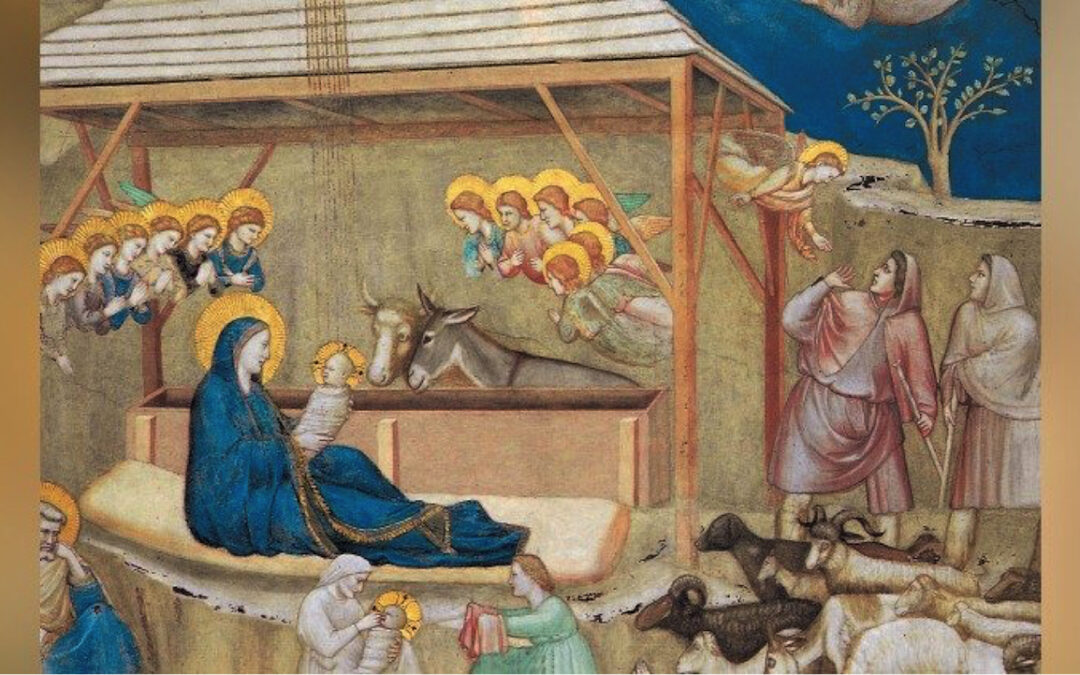
(Giotto, Nativity, Lower Basilica of St. Francis, Assisi, 1310)
Thursday, 25 December 2025
CHRISTMAS DAY – YEAR A
Commentary on the Sunday Gospel
Jn 1:1-18
Here we are, after this journey, in front of the cave in Bethlehem! The Creator becomes a creature. And today we find John’s prologue illuminating this humble space and helping us understand its mystery. It is a decidedly challenging text, at times difficult to understand. After all, today’s scene is difficult to understand: God, in his immensity, chose to strip himself of his divinity, to take on human nature, and we did not even give him a place to stay in the inn!
The prologue introduces us to the protagonist of the Gospel: the Word. It is a hymn to the Word, a beautiful poem! What better than a poem to describe beauty, to describe fullness?
The hymn presents the Word in its relationship with God, in its relationship with creation, in its relationship with history, until the Word becomes flesh, when we see God face to face, as if in front of this manger full of sweetness and mystery. What is the Word? If we think about it, the Word is what gives existence to every person. Without the Word, man does not exist, does not relate, does not live.
What is in the beginning is what will also be at the end, what awaits us. In the beginning, or rather, before the beginning, there was not chaos or confusion. In the beginning, there was no action, no fate. In the beginning, there was ‘the word’. The term ‘word’ derives from ‘paraballo’, meaning ‘to throw out’. With words, man throws himself out, exposes himself, offers himself, comes out of himself. Man is a word that is exposed and heard, responded to. God himself is word, freedom, communication, love. Those who speak do not say things, but say themselves, if they speak the truth. In fact, when two people no longer speak, it is a disaster. God is word, he is gift.
To say that in the beginning was the word also indicates that the word is in man’s destiny. This word, however, can be a lie. For this reason, Francis, who was the first to intuit the beauty of representing this cave as ‘living’, highlights in the Canticle the risk of the word, a source of lies to praise God, and prefers the use of all creation to the use of the word. By praising God through creation, at least there is no risk of being hypocritical or false.
With regard to creation, a Jewish story says that the world was created with the letters of the alphabet: a very clever way of saying that the world is intelligible, understandable. This is why Jews believe that the world is ‘dominated’ by giving names to things, using words. Everything happens through words.
God said, creating everything, light, sky, day, night, waters. When he created man, he created someone who could read creation. How much we are forgetting this gift of reading creation! If there is beautiful music and no one listens to it, this music is not beautiful, it does not even make sense. So we humans risk treating all the beauty of creation, emptying it of meaning with our indifference.
How many beautiful sunsets have we missed, with our eyes fixed on televisions or mobile phones? How many spectacular starry skies! Creation is an objective word; through words, man deifies, interprets creation, finds meaning in it, seeks the signature of the creator. Only man performs this task. However, it happens that the light that illuminates the world from this cave is not welcomed by darkness. There is fear in the world, a lie that does not grasp the word. To grasp means to understand, but also to imprison. The darkness cannot understand the light, but neither can it suffocate it. This double meaning gives value to the humility of this cave, to the drama of a God who is born but is not recognised by men. We will focus on the second part of the prologue next Sunday, the first Sunday of the new year, which will be accompanied by the same passages from the Gospel.
The most beautiful wish for this Christmas is to contemplate this scene in Bethlehem with the eyes of Saint Clare of Assisi, who said: “Place your eyes before the mirror of eternity, place your soul in the splendour of glory, place your heart in Him who is the image of the divine substance, and be transformed entirely through contemplation into the image of His divinity” (FF 2888).
The destiny of man is at stake in these words. In the light of these words, we can understand all the beauty of what happened in the manger in Bethlehem, and perhaps our Christmas, at the end of this journey of discovery over the past few weeks, takes on a sweeter flavour.
We sincerely wish you a Merry Christmas from the Lord.
Laudato si’!
We hope that today, in the midst of Christmas preparations, we can devote the right amount of time to the word of God. Best wishes to all.
That’s right, Michael, it won’t be easy to find the time today. And it’s a paradox…
Joyeux Noël à tous et à toutes
Merci Nathalie, joyeux Noël à vous aussi.
I reciprocate your wishes by thanking you for the important guidance you provide. For around 2000 years, a message of hope has quietly given meaning to what we do… Merry Christmas.